




High-Performance Tires: The Enthusiast’s Guide to Grip and Handling in 2026
Your $20,000 engine overhaul and precision-tuned coilover kit are effectively useless if your contact patch is the size of a smartphone and made of the wrong rubber compound. It's a harsh reality, but even the most sophisticated BMW or Porsche remains tethered to the laws of physics. You've likely felt the frustration of high-end tires wearing out prematurely on your modified build, or perhaps you've struggled to distinguish between "All-Season" and "All-Weather" options during a volatile Canadian spring.
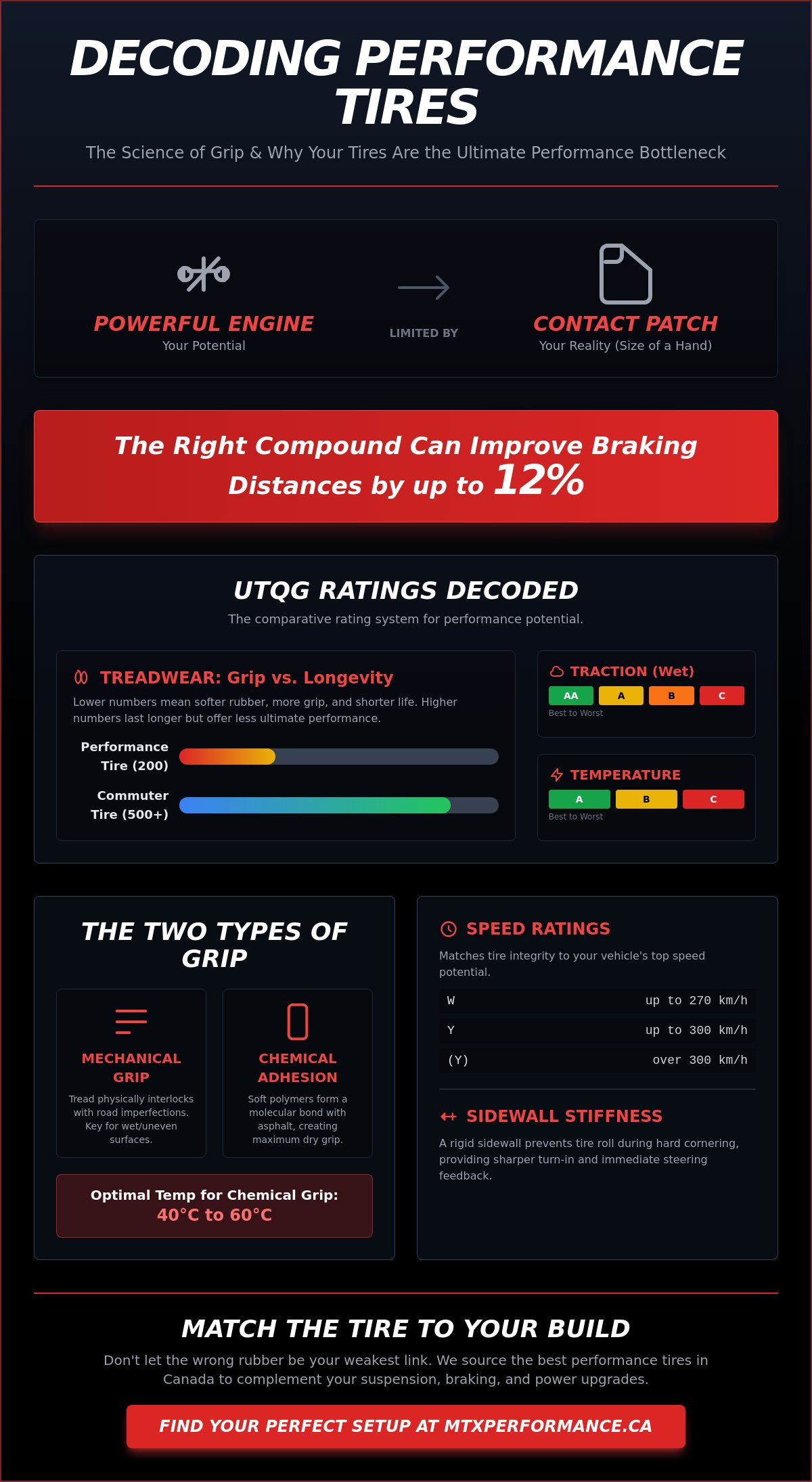
We understand that you demand more than just a black circle. You're looking for an engineering solution that complements your vehicle's increased torque and aggressive alignment. This guide masters the technical science behind 2026's performance compounds, promising to help you select a setup that can improve your braking distances by 12% and provide the high-speed stability required for the track. We'll decode UTQG ratings, explain why load ratings matter for your specific suspension geometry, and provide a clear roadmap to achieving maximum cornering grip without compromise.
Key Takeaways
- Understand why the contact patch is the ultimate performance bottleneck and how it dictates your vehicle's true limits in cornering and braking.
- Learn to decode technical specifications like UTQG and speed ratings to select rubber capable of handling your car’s maximum power output.
- Discover how to strategically match your high-performance tires to suspension and braking upgrades to ensure every component functions at peak efficiency.
- Identify the ideal seasonal compound for your driving style, from high-performance summer rubber to track-ready extreme performance options.
- Master the logistics of sourcing performance parts within Canada to eliminate surprise duty fees and ensure fast, nationwide shipping for your build.
Why Tires Are the Ultimate Performance Bottleneck
Your engine might produce 600 horsepower, but your vehicle's actual performance is limited by four patches of rubber no larger than a standard smartphone. This area, known as the contact patch, is the only thing connecting your high-performance machine to the Canadian asphalt. Whether you're navigating a tight corner at Mont-Tremblant or hard-braking on the 401, tires dictate the absolute physical limits of your car's capabilities. They're the final arbiter of how much of that power actually reaches the ground.
Standard premium tires focus on longevity, fuel economy, and noise reduction. In contrast, Ultra-High-Performance (UHP) rubber prioritizes lateral grip and heat dissipation. When you opt for a professional ECU recalibration to increase torque, stock tires often become the weakest link. They simply can't maintain traction under the aggressive load of a modified powertrain, leading to wasted energy and slower 0-100 km/h times. To understand these limits, enthusiasts often look at the Uniform Tire Quality Grading (UTQG), which provides a baseline for traction and temperature resistance, though it's only the starting point for true performance selection.
The Physics of Grip: Mechanical vs. Chemical
Grip isn't a single force; it's a combination of mechanical interlocking and chemical adhesion. Tread patterns provide mechanical grip by biting into road textures. However, at the limit, chemical adhesion becomes dominant. Soft-compound performance tires use specialized polymers that bond with the road surface at a molecular level. This process requires heat. A UHP tire typically needs to reach an internal temperature of 40°C to 60°C before the compound becomes sticky enough to deliver maximum lateral acceleration. Without this warm-up, even the most expensive tires will feel glassy and unpredictable.
Tires as a Tuning Tool
We view tires as a fundamental suspension component. Adjusting tire pressures by as little as 2 PSI can shift a car's balance from frustrating understeer to a neutral, rotatable stance. Sidewall stiffness is equally critical. A rigid sidewall improves turn-in response, giving the driver immediate feedback through the steering rack. Additionally, reducing unsprung weight through lighter tire and wheel combinations allows your suspension to react faster to road imperfections. In the world of high-end European tuning, choosing the right rubber is the most cost-effective way to shave seconds off a lap time or improve high-speed stability on the highway.
Decoding Performance Tire Specs: Beyond the Size
Selecting the right performance tires involves looking past the width and aspect ratio. The sidewall of a high-end tire contains a technical roadmap that defines how the car handles a tight apex or a high-speed run on the 401. Enthusiasts must interpret these codes to ensure their rubber matches their driving ambitions and vehicle weight.
Understanding Treadwear and Compound Softness
UTQG is a comparative rating system for treadwear, traction, and temperature. In the performance world, the treadwear number is the most critical metric. A "Treadwear 200" rating has become the gold standard for street-legal track tires used in many Canadian grassroots racing series. This number indicates a softer compound designed for maximum mechanical grip rather than longevity. While a standard commuter tire might boast a 500+ rating, performance compounds sacrifice mileage to achieve higher lateral G-forces. Lower numbers typically signify a more heat-resistant track compound that maintains its structural integrity when pushed to its limit. You can find more detail on these classifications in this Car and Driver tire buying guide, which breaks down how these ratings affect daily drivability.
Sidewall Construction and Heat Management
Performance driving generates immense kinetic energy that converts into heat. Modern rubber compounds utilize a precise blend of silica for wet-weather flexibility and carbon black for dry-weather stiffness. If a tire lacks proper heat management, it can "grease out," a condition where the surface becomes too hot and loses its adhesive properties. Reinforced sidewalls are equally vital. High-performance vehicles, especially heavy European builds from Porsche or BMW, require stiff sidewalls to prevent tire roll during aggressive cornering. This stiffness ensures the contact patch remains flat against the asphalt even under heavy load.
- Speed Ratings: Look for W (270 km/h), Y (300 km/h), or (Y) (300+ km/h) to match your car's top-end potential safely.
- Load Index: Heavy performance EVs and SUVs require XL (Extra Load) ratings. Using a standard load tire on a 2,500 kg electric sedan can lead to premature failure or unpredictable handling.
- DOT Date Code: Rubber begins to oxidize and harden the moment it leaves the factory. Always check the four-digit DOT code; the first two digits are the week and the last two are the year of manufacture.
Freshness is non-negotiable for safety. Even if the tread looks deep, tires older than 6 years lose the elasticity required for peak performance. If you're looking to optimize your vehicle's connection to the road, the specialists at MTX Performance can help you calibrate your setup for maximum precision. Don't let an outdated or mismatched load rating compromise your machine's engineering.
Seasonal Performance: Summer, Track, and All-Weather Options
Summer performance tires represent the gold standard for any high-output BMW or Porsche. These specialized compounds excel once ambient temperatures exceed 7 degrees Celsius. Below this specific threshold, summer rubber hits what engineers call the glass transition point. The chemical compound hardens, loses its vital flexibility, and can even develop structural cracks under load. This isn't just a performance sacrifice; it's a mechanical failure of the grip envelope. For drivers demanding maximum lateral G-forces, Extreme Performance Summer (EPS) options bridge the gap between daily usability and circuit-ready dominance.
The Canadian Performance Dilemma
Standard all-season tires are a compromise that limits your vehicle's potential in every season. They lack the biting edges for deep Canadian snow and the tread block stiffness required for spirited summer cornering. For the true enthusiast, a dedicated two-set strategy is the only path to excellence. You need Ultra-High Performance (UHP) summer rubber paired with high-performance winter tires designed for sub-zero stability. If a single-tire solution is unavoidable, ensure the sidewall features the Three-Peak Mountain Snowflake symbol. These All-Weather tires meet specific traction requirements for winter legality in provinces like Quebec, though they won't match the surgical precision of a bespoke summer setup. When evaluating your options, NHTSA's Uniform Tire Quality Grading standards provide an essential baseline for comparing heat resistance and traction ratings across different manufacturers.
Track-Focused Rubber for the Street
R-Compound tires prioritize absolute adhesion over longevity or comfort. These specialized tires often feature treadwear ratings between 40 and 100, indicating a soft, sticky composition. They're built for the driver who wants to drive to the track, shave seconds off their lap time, and return home on the same set. However, safety trade-offs are real. Most track-focused rubber starts with significantly less tread depth, often 5/32" compared to the 10/32" found on touring models. This reduction drastically increases hydroplaning risks during heavy rainfall on the 401 or the Decarie Expressway.
You must also manage heat cycles. Every time the rubber reaches peak operating temperature and cools, the chemical bonds permanently change. After approximately 15 to 25 heat cycles, the compound often hardens. The tire might look like it has plenty of tread remaining, but the mechanical grip has evaporated. Precision driving requires an expert understanding of these thermal limits to maintain peak performance on every corner.
The Synergy of Grip: Matching Tires to Your Build
A performance build is only as strong as its weakest link. You can't expect a car to handle like a precision instrument if the rubber meeting the road isn't up to the task. High-performance tires act as the final translator for every modification you've bolted onto your chassis. Without the correct compound and construction, your high-dollar upgrades are effectively neutered, leaving untapped potential on the table.
Complementing Your Suspension Upgrades
High-end suspension systems are designed to manage weight transfer with surgical precision. When you install Ohlins Road & Track coilovers, you're gaining the ability to control body roll and pitch. However, the coilover's job is to keep the tire pressed against the pavement. If the sidewall is too soft, it'll roll over during hard cornering, negating the benefits of your damping settings. Stiff sway bars further increase the demand on your contact patch. You need a tire that can withstand these lateral forces without deforming. Additionally, aggressive alignment settings, such as 2.5 degrees of negative camber, require a tire with reinforced shoulders to prevent uneven wear and maintain stability at the limit.
Tires and Stopping Power
Braking performance is often misunderstood as being solely about rotors and pads. While your Power Stop brakes provide the necessary clamping force, the tires determine the actual stopping distance. If the tire compound is too hard, the ABS will engage prematurely because the rubber can't maintain friction against the asphalt. This "clamping limit" is where many builds fail. A wider tire footprint also plays a vital role in heat management. During a 100-0 km/h emergency stop, the friction generates immense heat; a high-performance tire dissipates this thermal energy more effectively, preventing the rubber from becoming "greasy" and losing its bite during repeated high-speed decelerations.
Power Delivery and Aesthetic Fitment
For high-horsepower RWD and AWD platforms, managing wheel spin is a constant battle. A 500-horsepower build on budget rubber will simply spin through the first three gears, wasting power and increasing wear. Upgrading to a tire with a lower UTQG rating ensures that torque is converted into forward momentum. Beyond the physics of speed, the aesthetic factor is undeniable. Achieving the perfect "flush" fitment requires a meticulous balance of wheel offset and tire profile. A 35-series tire on a 19-inch wheel provides the sharp, aggressive stance that defines a premium build, ensuring the sidewall looks as purposeful as it performs.
Ready to optimize your vehicle's connection to the road? Consult with the experts at MTX Performance to find the perfect tire and suspension synergy for your build.
Sourcing Performance Tires in Canada: The MTX Advantage
Your build shouldn't wait on a customs clearance officer in a border warehouse. High-performance driving demands precision, and that precision starts with how you source your rubber. MTX Performance provides fast nationwide shipping across Canada, ensuring your project stays on schedule. We've optimized our logistics network to move products quickly from our inventory to your garage, bypassing the typical 10 to 14 day wait times associated with international shipping.
Hidden fees kill project budgets. Ordering from international retailers often triggers surprise brokerage fees and duty charges that can add 20% or more to your total cost. By sourcing your tires through MTX Performance, you pay the price you see. We eliminate the C$50 to C$150 administrative fees often tacked on by cross-border couriers. Buying local means your capital goes into the quality of the component, not into border paperwork.
Our team doesn't just read spec sheets; we understand how a specific compound interacts with your suspension geometry. We provide expert technical advice to match your specific vehicle build to the right brand. Whether you're chasing lap times at Canadian Tire Motorsport Park or looking for a reliable ultra-high-performance summer setup for the street, we ensure the load ratings and speed symbols are perfectly matched to your car's output. Enthusiasts in the Ontario region can also take advantage of local pickup, providing an immediate solution for those who need to get back on the road or track without delay.
Why Buying Canadian Matters for Your Build
Supporting the Canadian enthusiast community keeps local performance expertise alive. When you buy within the country, you secure simplified returns and warranty support that international retailers can't match. If a manufacturer defect occurs, you aren't stuck paying C$200 in return shipping to a foreign warehouse. It's about accountability and local pride. You can explore more build inspiration in our detailed guide on Auto Parts in Canada.
Completing Your Performance Package
A set of premium tires is only one part of the equation. Combining your order with performance exhaust systems allows you to save on shipping logistics while transforming both the grip and the acoustic profile of your vehicle. We specialize in technical fitment, offering professional advice on sizing for complex staggered setups and wide-body kits. We curate brands trusted by the global tuning community to ensure every component we sell meets the highest standards of engineering excellence.
Maximize Your Machine’s Potential
Your vehicle's performance is only as good as its contact with the asphalt. We've explored how modern tires act as the final arbiter of speed, turning raw horsepower into precise lateral grip and acceleration. Choosing the right compound isn't just a maintenance task; it's a critical engineering decision that defines how your car communicates through every corner. Precision matters when you're pushing the limits of 2026's best automotive platforms.
At MTX Performance, we eliminate the guesswork from your setup. As an authorized dealer for elite global brands, we provide the technical precision your high-end build demands. Our experts offer dedicated technical support to ensure your specs are perfect, while our fast nationwide Canadian shipping ensures you aren't left waiting. We handle the logistics so you can focus on the drive. Don't settle for mediocre rubber when your car was built for excellence.
Upgrade your grip with MTX Performance's curated tire selection
The right set of rubber transforms a good car into a masterpiece. Get out there and experience the difference that true performance engineering makes on the road.
Frequently Asked Questions
What is the difference between All-Season and All-Weather tires?
All-weather tires carry the Three-Peak Mountain Snowflake (3PMSF) symbol, meaning they meet specific snow traction performance requirements. Unlike standard all-seasons, these tires remain flexible at temperatures below 7 degrees Celsius. In provinces like Quebec, this certification makes them legal for winter use between December 1 and March 15. All-season models typically lose 25 percent of their grip once the thermometer hits the freezing mark.
How do I know if a performance tire will fit my modified suspension?
You must measure the clearance between the inner sidewall and your strut or coilover assembly, aiming for a minimum 5mm gap. Modified suspensions often change the scrub radius and camber curves, which affects how the tire sits in the wheel well. We recommend using a digital caliper to verify that your chosen width doesn't cause rubbing during a full 360-degree steering rack rotation.
Why do my performance tires seem louder than my old commuter tires?
High-performance tires utilize larger tread blocks and stiffer sidewalls to maximize lateral grip and steering response. These design choices create more air turbulence in the grooves and transmit more vibration through the chassis. While a standard commuter tire focuses on a 65-decibel cabin experience, a track-ready compound prioritizes a 15 percent increase in cornering force over acoustic comfort.
Can I use track-focused R-compound tires for daily driving in Canada?
Using R-compound tires for daily Canadian driving is dangerous because they require internal temperatures of 60 to 80 degrees Celsius to provide adequate traction. On a typical 15-degree morning in Ontario or BC, these tires behave like hard plastic. They also feature minimal grooving, which increases hydroplaning risk by 40 percent on wet highways compared to dedicated maximum performance street tires.
How often should I rotate tires on a high-horsepower RWD car?
Rotate your tires every 5,000 to 8,000 kilometers to ensure even wear across the contact patch. High-torque rear-wheel-drive platforms like the BMW M4 or Porsche 911 accelerate rear tread depletion by up to 30 percent compared to the front. If your vehicle uses a staggered fitment where rear wheels are wider than the fronts, you can only rotate side-to-side, provided the tread pattern isn't directional.
What does the Treadwear rating actually tell me about a tire's life?
The Treadwear rating is a comparative index where a 200-rating tire should technically last twice as long as a 100-rating tire under controlled conditions. It's not a guarantee of mileage. For enthusiasts, a rating below 200 usually indicates a sticky, soft compound designed for maximum heat cycles. A 500-rating tire focuses on longevity and fuel economy rather than shaving seconds off a lap time.
Do I need to recalibrate my speedometer if I change tire sizes?
Recalibration is necessary if your new tire diameter differs from the OEM specification by more than 3 percent. If you install a tire that's 5 percent larger in total height, your speedometer will display 95 km/h when your actual road speed is 100 km/h. This discrepancy affects your odometer accuracy and can disrupt the shift logic in modern 8-speed or 10-speed automatic transmissions.
Why is tire pressure more critical for performance tires than standard ones?
Performance tires operate within a much narrower thermal and pressure window to maintain their structural integrity at high speeds. A variance of just 2 PSI can alter the contact patch shape enough to reduce lateral stability by 12 percent. For precision machines like an Audi RS or a Volkswagen Golf R, maintaining the manufacturer's cold pressure setting ensures the sidewall supports the load properly during aggressive turn-in.