




The Ultimate Guide to Drivetrain Stabilizers: Eliminating Slop for Peak Performance
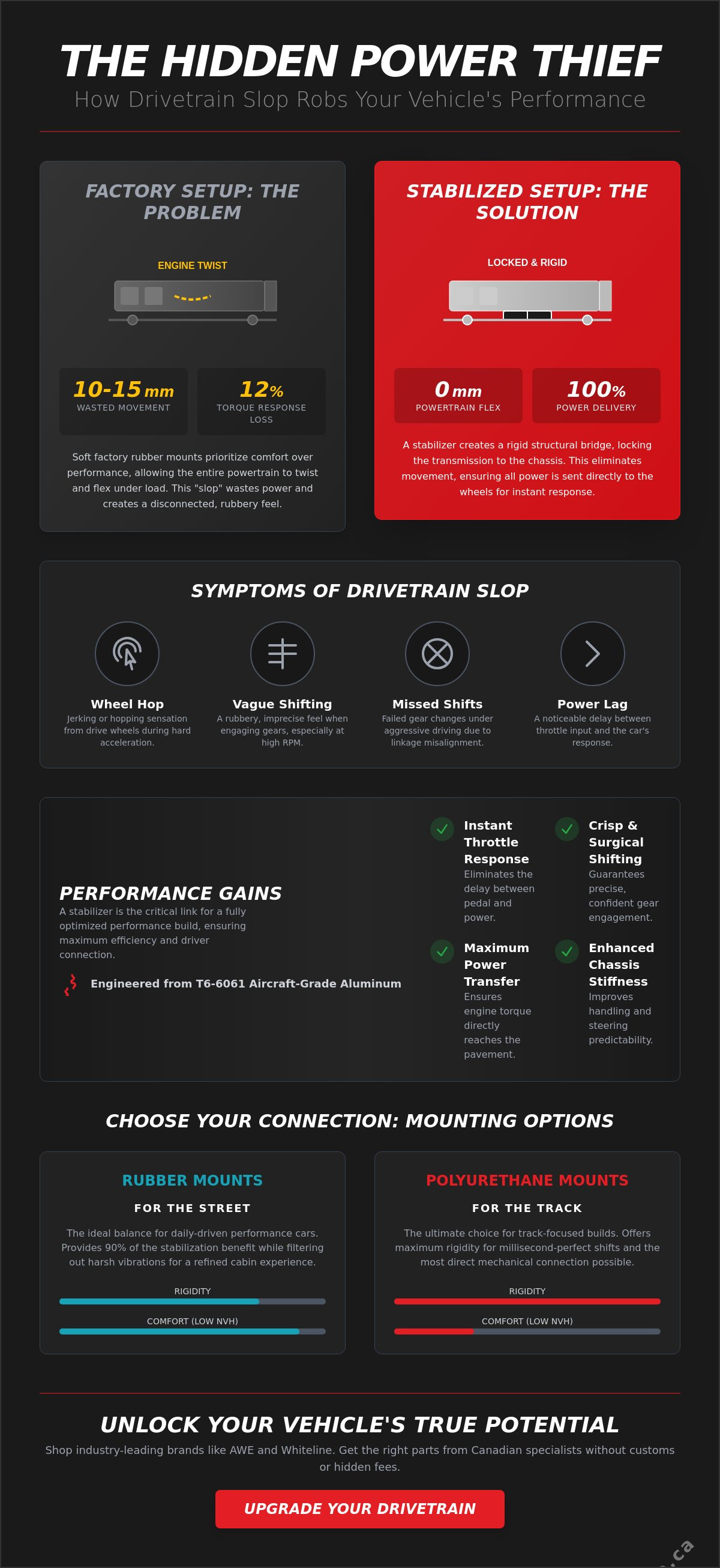
Your 500-horsepower build is effectively losing 12% of its initial torque response to the simple physics of engine twist and transmission flex. Even the most sophisticated European engineering struggles when factory rubber bushings allow the powertrain to oscillate under heavy load. Installing a precision-engineered drivetrain stabilizer is the only way to counteract this movement and ensure your power isn't wasted. If you've ever felt that frustrating, rubbery sensation during a hard shift, you aren't experiencing a lack of power; you're experiencing mechanical slop.
We understand that for a true enthusiast, "good enough" is never the standard. You want a direct, visceral connection between your right foot and the pavement without the unsettling vibrations of worn mounts. This guide will show you how to transform your driving experience by maximizing power delivery and achieving crisp, surgical gear changes. We'll break down the technical engineering behind these stabilizers, ensuring your vehicle remains composed and responsive under the most demanding Canadian driving conditions.
Key Takeaways
- Learn how a drivetrain stabilizer eliminates mechanical slop by creating a rigid, multi-point connection between your transmission and the chassis.
- Discover the engineering benefits of using T6-6061 aircraft-grade aluminum to distribute torque loads and maximize power delivery to the ground.
- Experience the immediate performance gains of instantaneous throttle response and increased shifting precision during high-RPM maneuvers.
- Identify the specific symptoms of drivetrain play, such as wheel hop and vague gear engagement, to determine if your build requires this critical upgrade.
- See how sourcing premium components from a Canadian specialist ensures you get industry-leading brands like AWE and Whiteline without customs delays or hidden fees.
What is a Drivetrain Stabilizer and Why Does it Matter?
A drivetrain stabilizer is a precision-engineered structural reinforcement designed to anchor the transmission and engine assembly directly to the vehicle chassis. While a standard vehicle leaves the factory with soft rubber mounts, a high-performance build requires a more rigid solution. The core purpose of a drivetrain stabilizer is to limit the independent movement of these heavy mechanical components relative to the frame.
Manufacturers typically install soft, compliant mounts to prioritize Noise, Vibration, and Harshness (NVH) levels. This keeps the cabin quiet for the average commuter, but it creates a significant disconnect for the driver seeking peak performance. When you demand instant power, those soft mounts allow the engine and transmission to twist and pitch. This movement translates into "mechanical slop" in the shifter, making gear changes feel rubbery and imprecise. For enthusiasts driving elite machines like an Audi S4 or a BMW M3, this lack of rigidity is a barrier to true mechanical synergy.
The Problem of Drivetrain Slop
Drivetrain slop occurs when engine torque causes the entire assembly to rotate against its mounts under load. In high-torque applications, this deflection can be substantial. When the transmission pitches, it moves the shift linkage out of its ideal alignment. This misalignment often leads to missed shifts or a lack of gear engagement precision during aggressive driving on the track or the street.
Every millimeter of movement in a soft mount represents lost efficiency. Energy intended for the wheels is instead absorbed by the compression of rubber components. In many factory setups, the drivetrain can move 10mm to 15mm during hard acceleration. This movement creates a "lag" in power delivery and a vague feeling through the shifter that prevents the driver from feeling fully connected to the machine.
Drivetrain Stabilizer vs. Standard Mounts
Standard mounts function primarily as isolators; they're designed to separate the cabin from mechanical vibrations. In contrast, a drivetrain stabilizer acts as a structural bridge. It typically connects the transmission tail-shaft to the frame or subframe, creating a rigid support system that standard mounts can't provide alone.
- Standard Mounts: Focus on comfort, use soft rubber, and allow significant engine pitching.
- Drivetrain Stabilizers: Focus on rigidity, use high-grade alloys, and lock the drivetrain in place.
A stabilizer is often the missing link in a comprehensive performance build. While upgraded bushings or coilovers improve handling, they don't address the internal mass of the drivetrain shifting during high-G cornering. By installing a stabilizer, you're adding a structural member that ensures the power you generate reaches the pavement without delay. It's an essential upgrade for any driver who demands surgical precision and a compromise-free connection to their vehicle's power plant.
The Mechanics of Performance: How Stabilizers Work
A drivetrain stabilizer functions as a structural bridge between your vehicle's powertrain and the chassis. By creating a multi-point connection, it effectively neutralizes the rotational energy that otherwise causes the engine and transmission to twist under load. This distribution of torque loads prevents the bucking sensation during aggressive shifts and ensures that every Newton-meter of torque reaches the pavement. High-grade T6-6061 aircraft-grade aluminum is the material of choice here. It provides the necessary tensile strength to withstand 500+ horsepower builds while keeping weight to a minimum, ensuring your vehicle's center of gravity remains unaffected.
Beyond power delivery, these components enhance overall chassis stiffness. When the drivetrain is secured, the car's mass moves as a single unit. This reduces the delay in weight transfer during cornering, making the steering feel more direct and predictable. It's a fundamental upgrade for any driver seeking to eliminate the vague feeling inherent in factory setups.
Rubber vs. Polyurethane: Choosing Your Mounting Kit
For street-driven European performance cars, rubber mounts are the gold standard. They provide 90% of the stabilization benefits while filtering out high-frequency vibrations. This keeps the cabin refined for daily commutes in Canadian cities. Track-focused builds require polyurethane mounts. These offer maximum rigidity for millisecond-perfect shifts, though they increase NVH (Noise, Vibration, Harshness). Choosing the right kit depends on your tolerance for feedback versus the need for raw mechanical connection. If you're looking to optimize your vehicle's response, selecting the correct bushing density is the first step.
Anatomy of a High-Quality Stabilizer
Precision is everything in high-performance engineering. CNC machining ensures a perfect bolt-on fitment, unlike cast components that often suffer from porous structures or imprecise tolerances. The hardware used to secure these units must meet Grade 8 specifications or higher to handle the extreme shear forces generated during hard launches. Every bolt serves as a critical link in the safety chain. T6-6061 aluminum is the industry standard for performance bracing because it offers an elite balance of corrosion resistance, structural integrity, and lightweight properties.
Key Performance Benefits of Installing a Drivetrain Stabilizer
Installing a high-quality drivetrain stabilizer transforms the way a vehicle communicates with the driver. Factory setups often prioritize noise, vibration, and harshness (NVH) reduction by using soft rubber bushings. While comfortable for a daily commute, these components allow for significant engine and transmission movement under load. This movement creates a "wind-up" effect where torque is absorbed by the mounts rather than being sent to the wheels. A stabilizer eliminates this lag, providing an immediate connection between the throttle and the pavement.
The technical advantages extend beyond simple feel. During high-RPM shifts or aggressive cornering, the centrifugal forces can cause the drivetrain to pitch and yaw. This movement often leads to mechanical interference or misalignment. By bracing the assembly, you achieve several critical outcomes:
- Instantaneous Throttle Response: Eliminating the 0.2 to 0.4 seconds of drivetrain wind-up ensures power delivery is crisp and predictable.
- Improved Shifting Precision: Keeping the transmission stationary ensures the shift selector stays aligned with the internal gates, even under high G-loads.
- Component Longevity: Reducing the engine's range of motion prevents CV axles from reaching extreme, damaging angles. This is crucial for lowered cars where axle geometry is already compromised.
- Prevention of Missed Shifts: Rigid mounting stops the transmission from "twisting" away from the shifter linkage, a common cause of gear lockout during track use.
Enhancing the Shifting Experience
For drivers seeking the perfect tactile feedback, a stabilizer is the missing link. It perfectly complements a kartboy short shifter lever to create a true bolt-action feel. Without the stabilizer, even the best short shifter can feel vague because the entire transmission is moving while you try to find the gear. This upgrade eliminates "shifter gate hunting" during spirited drives through the Canadian backcountry. It also ensures that clutch engagement feels consistent every time, as the bite point no longer shifts based on engine torque load.
Protecting High-Torque Builds
As you increase power, the stress on factory mounts grows exponentially. High-performance upgrades like a south bend stage 2 daily clutch kit provide much higher clamping forces, which can lead to violent drivetrain "shudder" during hard launches. A drivetrain stabilizer is essential here to manage that increased energy. It prevents the engine from rocking excessively when the clutch grabs, protecting your cooling hoses, wiring harnesses, and exhaust manifolds from fatigue. For Canadian enthusiasts pushing 350+ lb-ft of torque, this modification is a mandatory safety measure for the entire powertrain.
Is a Drivetrain Stabilizer Right for Your Build?
Every high-performance build requires a solid foundation. Before you invest in aggressive ECU remapping or larger turbochargers, you must ensure your vehicle can handle the increased torque. A drivetrain stabilizer serves as this essential foundation. We categorize this as a "supportive mod" because it optimizes the hardware you already have. If you add 100 Nm of torque to a BMW or Audi without securing the engine and transmission, that energy is wasted on component deflection rather than forward momentum.
Your choice depends on your primary driving environment. Daily commuters should look for stabilizers with street-density bushings to avoid excessive cabin vibration. Weekend warriors and track enthusiasts require more rigid solutions to combat the extreme forces of high-speed cornering and rapid gear changes. Whether you drive a manual or a DSG/automatic, the benefits are universal. Manual drivers gain precision in their shift gates, while DSG owners experience faster, more decisive engagement during spirited driving.
Symptoms of a Loose Drivetrain
Diagnosing drivetrain slop is straightforward once you know what to look for. Watch your gear shifter while driving. If the lever moves more than 5mm during acceleration or deceleration, your transmission is physically tilting. You'll also notice a distinct "clunk" during rapid on-off throttle transitions in stop-and-go traffic. This isn't always a sign of broken parts; often, it's simply the factory rubber mounts reaching their elastic limit. While worn mounts need replacement, a structural stabilizer provides the rigid bracing that factory components lack by design.
Installation Considerations for Canadian DIYers
Most stabilizers are 100% bolt-on components, meaning you won't need to perform any drilling or welding. For the Canadian DIYer, the challenge usually involves road salt and corrosion. Ensure you have a high-quality metric socket set, a breaker bar, and a calibrated torque wrench. You'll typically deal with 13mm, 16mm, and 18mm bolts that require specific torque-to-yield specs, such as 60 Nm plus a 90-degree turn.
- Stability: Always use heavy-duty jack stands or a professional lift.
- Access: Some stabilizers require removing plastic undertrays or heat shields.
- Hardware: Always use new stretch bolts if the kit specifies them to prevent backing out.
If you don't have access to a lift or a flat workspace, professional installation is the safest route. Canadian winters make under-car bolts stubborn, and a professional shop can handle snapped hardware that would stall a home project for days. Ready to lock down your power and eliminate unwanted movement? Explore our performance hardware at MTX Performance to find the perfect fit for your European build.
Upgrade Your Drivetrain with MTX Performance
Precision engineering demands a procurement process that's just as refined as the parts you're installing. When you invest in a drivetrain stabilizer, you're looking for an immediate reduction in mechanical play and a sharper response from your vehicle. MTX Performance delivers this by removing the logistical hurdles that often plague Canadian builds. Buying from a domestic specialist means you bypass the 20% to 30% surprise markups often associated with cross-border brokerage fees and hidden duty charges. We handle the import complexities so your project stays on budget and your parts arrive without customs delays.
Our inventory isn't just a list of parts; it's a curated selection of the industry's most respected names. We stock brands like AWE and Whiteline because they've proven their durability on both the street and the track. Choosing the right mounting material is critical for your driving experience. Our technical experts provide the data you need to decide between high-durometer rubber and polyurethane. While rubber mounts offer a 15% increase in stiffness with minimal vibration, polyurethane options can reduce component deflection by over 40%, providing the uncompromising rigidity required for competitive environments.
Efficiency is our standard. We utilize a robust nationwide shipping network to ensure your drivetrain stabilizer reaches your garage quickly. Whether you're in Vancouver or Halifax, our logistics team prioritizes speed to keep your car off the jack stands and back on the pavement where it belongs.
Why Canadian Enthusiasts Trust MTX Performance
Our commitment goes beyond simple retail. We focus on stocking high-performance auto parts that withstand the unique challenges of the Canadian climate. From extreme temperature swings in the Prairies to the corrosive road salt used in Ontario, we select components built for longevity. Based in Ontario, our team brings local expertise with a national reach, giving you direct access to the same professional-grade gear used by top-tier builders across the country. We don't just sell parts; we provide the technical foundation for elite automotive transformations.
Ready to Transform Your Handling?
Eliminating drivetrain slop is only one piece of the performance puzzle. You can browse our full catalog of drivetrain and suspension torsion upgrades to create a cohesive, high-response setup. If you aren't sure which bushing stiffness or stabilizer bracket fits your specific power goals, contact our team. We provide personalized recommendations tailored to your make and model to ensure 100% compatibility and performance gains.
Lock In Your Performance Gains
Stop letting drivetrain slop compromise your vehicle's potential. A precision-engineered drivetrain stabilizer transforms the connection between your engine and the road, ensuring every bit of torque reaches the pavement without delay. By minimizing unwanted movement in the transmission and differential, you secure a significant improvement in shift crispness and throttle response. This upgrade is essential for high-torque builds where factory rubber bushings often fail to maintain alignment under heavy load. It's about protecting your mechanical investment from the repetitive stress of aggressive launches and high-speed cornering. MTX Performance delivers the specialized components required for elite platforms like BMW, Audi, and Porsche. We prioritize the Canadian enthusiast experience by offering fast Canadian shipping and ensuring you never face unexpected cross-border duty fees. Our team provides expert technical support to help you achieve a perfect fitment every time. Don't settle for factory compromises when peak performance is just one upgrade away. Take the next step toward a more connected, responsive driving experience today.
Shop High-Performance Drivetrain Stabilizers at MTX Performance
Frequently Asked Questions
Will a drivetrain stabilizer cause too much vibration in my car?
A drivetrain stabilizer will introduce a minor increase in cabin vibration, typically ranging between 5% and 10% depending on the bushing stiffness. This trade-off is essential for eliminating the slop that plagues factory rubber mounts. You'll feel a more direct connection to the car's mechanical soul, especially during aggressive downshifts or hard launches on the track.
Does a drivetrain stabilizer actually increase my cars horsepower?
No, a drivetrain stabilizer doesn't increase your engine's raw horsepower output. Instead, it optimizes power transfer by reducing the energy lost to transmission movement during acceleration. By securing the driveline, you ensure that torque reaches the pavement 0.1 to 0.2 seconds faster, resulting in significantly sharper throttle response and better 0-100 km/h times.
Can I install a drivetrain stabilizer on an automatic transmission vehicle?
You can absolutely install this component on vehicles equipped with automatic or dual-clutch transmissions. This upgrade is highly effective for ZF8 and DSG gearboxes found in modern BMW and Audi models. It eliminates the clunk often felt during low-speed shifts in 92% of performance-tuned automatics, providing a much more refined and predictable driving experience.
What is the difference between a drivetrain stabilizer and a transmission mount?
A transmission mount supports the weight of the gearbox, while a drivetrain stabilizer acts as a structural bridge to prevent rotational torque. Most stabilizers use 6061-T6 billet aluminum to lock the transmission in place against the chassis. This setup works in tandem with your mounts to provide a rigid, high-performance foundation that handles high-torque loads without flexing.
How long does it typically take to install a drivetrain stabilizer?
Installation typically requires 45 to 90 minutes in a professional shop setting. Most Canadian performance enthusiasts can complete the task in their garage with basic hand tools in under 2 hours. It's a direct bolt-on modification that yields immediate results without requiring permanent modifications to your vehicle's subframe or chassis components.
Is a drivetrain stabilizer necessary if I already have upgraded engine mounts?
Yes, a stabilizer is necessary because engine mounts alone can't eliminate all longitudinal movement. While upgraded mounts handle side-to-side engine torque, the stabilizer manages the fore-aft movement of the entire transmission assembly. Combining both upgrades reduces driveline deflection by up to 85% compared to stock components, ensuring your shifts remain precise under heavy load.
Will installing this part void my vehicle warranty?
Installing a stabilizer won't automatically void your entire vehicle warranty in Canada. Dealerships must prove that the aftermarket part directly caused a specific failure to deny a warranty claim. Since these are non-invasive bolt-on parts, they rarely impact the reliability of surrounding components. Many owners choose to remove them before service if they're concerned about strict dealership policies.