




Performance Exhaust Systems: The Ultimate Canadian Enthusiast’s Guide
Why do so many Canadian enthusiasts sacrifice their cabin comfort for a 15 horsepower gain that comes with an unbearable highway drone? You've worked hard to put a precision machine like an Audi or BMW in your garage, so you shouldn't have to settle for a generic exhaust that rusts after two seasons of road salt or hits you with 30% import duties from US retailers. We understand the frustration of deciphering technical jargon while trying to achieve that perfect, exotic tone without the headache of cross-border shipping.
It's time to stop guessing and start engineering your build for results. You're about to master the technical nuances of flow dynamics, backpressure, and the structural superiority of T304 stainless steel. This guide eliminates the confusion around mandrel bending and sound frequencies so you can choose a system that delivers immediate throttle response and lasting durability. We'll show you how to secure a high-performance setup that withstands the harsh Canadian climate and sounds absolutely elite.
While this guide focuses on the Canadian market, it's worth noting the breadth of the global automotive parts scene, with major European distributors like elartcom.eu offering a vast inventory for those familiar with international sourcing.
Key Takeaways
- Master the science of flow by understanding how scavenging and mandrel bending optimize your exhaust system for peak engine efficiency and power.
- Evaluate the performance-to-cost ratio of cat-back and axle-back configurations to ensure your investment delivers the maximum ROI for your specific build.
- Learn to identify and eliminate intrusive cabin drone using precision acoustic engineering, preserving a high-end sound profile for both daily driving and spirited runs.
- Streamline your upgrade process by sourcing elite brands like AWE and Borla domestically to bypass cross-border delays and unexpected import fees in C$.
Understanding Modern Performance Exhaust Systems
A performance exhaust isn't just a louder pipe. It's a precision-engineered solution to a fundamental mechanical bottleneck. Your engine functions as a high-speed air pump. To generate maximum power, it must expel spent gases with minimal resistance. A high-quality system optimizes this path, reducing backpressure and allowing the engine to breathe. This translates to immediate gains in throttle response and a more visceral connection to the machine. Whether you're navigating the 427 or heading toward the GTA's track circuits, the right setup transforms the vehicle's character.
Every internal combustion engine follows the four-stroke cycle: intake, compression, power, and exhaust. While most drivers focus on the power stroke, the final stage determines the efficiency of the next cycle. If the Exhaust system fails to clear the combustion chamber effectively, residual heat and gases dilute the fresh intake charge. This contamination reduces the energy of the subsequent power stroke. By streamlining this exit, we ensure that each intake stroke draws in the purest air-fuel mixture possible.
Manufacturers build cars for the average commuter, not the performance enthusiast. They prioritize low production costs and strict noise decibel limits over raw efficiency. Most OEM systems are designed to meet a price point. This compromise leaves significant horsepower on the table, often stifling the true potential of high-end platforms like Audi, BMW, or Porsche. Beyond the numbers, there's a psychological shift when you hear a refined note. It's the difference between a muffled hum and a crisp, mechanical symphony. A tuned system provides acoustic feedback that makes every gear shift more rewarding, turning a routine drive into an immersive experience.
The Core Components of a Performance Build
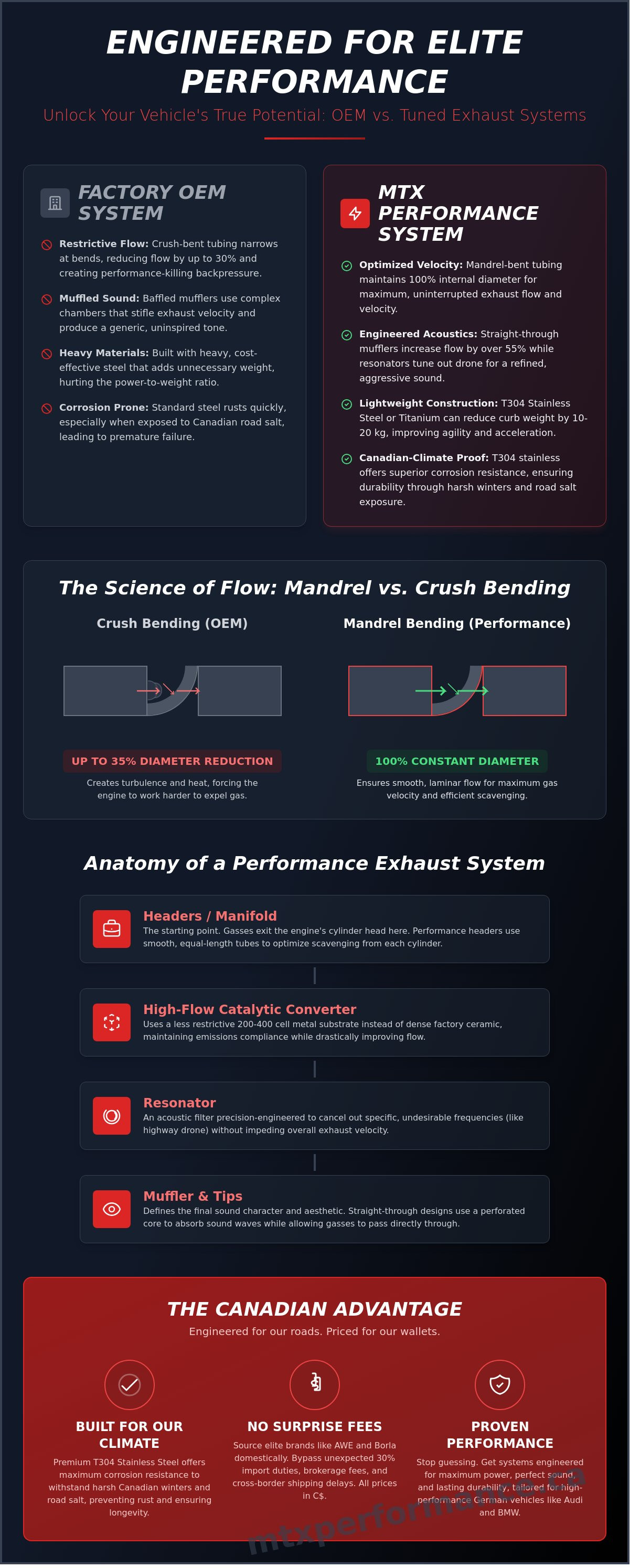
The journey begins at the headers, where gases exit the cylinder head. From here, they pass through the catalytic converter. This component is vital for emissions compliance in Ontario. Modern high-flow converters use a 200-cell or 400-cell metal substrate instead of the dense, restrictive ceramic found in factory units. Next, resonators cancel out specific harsh frequencies to prevent cabin "drone" at highway speeds. Finally, the mufflers and tips define the final acoustic character and aesthetic finish. Each part must work in harmony to maintain optimal gas velocity.
Why OEM Systems Stifle Your Engine
- Tubing Design: Factory pipes often use crush-bent tubing. This process creates restrictive ripples and narrows the diameter at every bend, sometimes reducing flow by 30 percent. Performance setups utilize mandrel-bent tubing to maintain a constant internal diameter throughout every curve.
- Internal Obstruction: Baffled mufflers force gas through complex internal mazes to kill noise. This creates massive backpressure. Switching to a straight-through, perforated core design can increase flow by over 55 percent.
- Weight Penalties: Standard exhaust components are heavy. Replacing a bulky steel factory unit with a T304 stainless steel or titanium alternative can shave 10 to 20 kilograms off your car's curb weight, directly improving your power-to-weight ratio.
The Science of Flow: How Exhausts Generate Power
Many drivers believe backpressure creates torque. It's a fundamental misunderstanding of fluid dynamics. Your engine doesn't need restriction; it needs velocity. High-performance exhaust systems focus on scavenging. This process uses the inertia of moving gas pulses to pull the next pulse out of the combustion chamber. When a system is tuned correctly, it creates a vacuum effect that clears the cylinder more efficiently than stock piping. This leads to a cleaner burn and immediate power gains.
Pipe diameter transitions utilize the Venturi effect. By strategically narrowing the pipe at specific points, gas velocity increases. Faster gas means better scavenging. If a pipe is too large, gas cools and slows down, killing low-end performance. Precision engineering ensures the diameter matches your engine's displacement and RPM range perfectly. While optimizing for raw power, we always respect emissions regulations to ensure the vehicle remains street-legal while pushing its mechanical limits.
Mandrel Bending vs. Compression Bending
Standard factory pipes often use compression or "crush" bending. This method reduces the internal diameter by up to 35% at every curve. These restrictions cause turbulence and heat soak, forcing the engine to work harder to push air out. Mandrel bending uses a solid rod inside the pipe during the bending process. This maintains a 100% constant diameter through every 45 or 90-degree turn. For forced induction builds, this allows turbochargers to spool up to 300 RPM faster, delivering torque much earlier in the power band.
Material Selection for the Canadian Climate
Ontario winters are brutal on underbody components. T409 stainless steel is common in mid-range systems, but it develops surface rust within one season of salt exposure. T304 stainless steel is the gold standard for Etobicoke drivers. It contains higher chromium and nickel levels, making it virtually immune to road salt corrosion. It's a "set it and forget it" solution for the life of the vehicle.
- T304 Stainless: Maximum corrosion resistance and durability in C$1,500+ systems.
- Titanium: Offers a 45% weight reduction over steel with a distinct, exotic exhaust note.
- Ceramic Coating: Can reduce engine bay temperatures by 150 degrees Celsius, protecting sensitive components.
Thermal management is the final piece of the performance puzzle. High-quality heat shielding and ceramic coatings keep the heat inside the pipes. This maintains gas velocity and protects your engine bay from heat soak during spirited driving. If you're looking for a bespoke setup that balances weight and longevity, our team can help you select the ideal configuration for your specific vehicle. Every gram saved and every degree dropped translates directly to a more responsive driving experience on the 427 or the track.
Cat-Back, Axle-Back, and Beyond: Choosing Your Configuration
Selecting an aftermarket exhaust system requires a calculated balance between acoustic goals, power targets, and your specific budget. In the performance world, we categorize these upgrades by how much of the factory piping they replace. Each configuration offers a distinct cost-to-performance ratio. A simple rear-section swap might cost C$500, while a full race-spec system can exceed C$4,500. Understanding these tiers ensures you don't overspend on hardware that exceeds your vehicle's current state of tune.
Installation complexity varies significantly across these categories. Bolt-on rear sections are generally DIY-friendly for those with a jack and basic sockets. Mid-section replacements often require more precision to avoid rattles or clearance issues with the driveshaft. For full systems, professional installation is mandatory to ensure gas-tight seals and proper alignment of oxygen sensors. We prioritize precision engineering to ensure every component integrates seamlessly with your vehicle's chassis.
Axle-Back Systems: Sound and Aesthetics
Axle-back configurations focus exclusively on the components from the rear axle to the tips. This setup typically includes the mufflers and the final exit pipes. It's the ideal choice for enthusiasts who want a more aggressive cold start and a deeper tone under load without the drone associated with larger piping. You'll see weight savings of 5 kg to 12 kg compared to bulky OEM steel units. While performance gains are modest, usually under 3 horsepower, the visual impact of high-polished or carbon fiber tips provides a high-end finish for a lower investment, typically ranging from C$600 to C$1,400.
Cat-Back Systems: The Performance Sweet Spot
The cat-back is the industry standard for a reason. It replaces everything from the catalytic converter outlet to the rear bumper. By increasing pipe diameter and optimizing the resonator, these systems reduce backpressure significantly. Manufacturers utilize computational fluid dynamics models to analyze gas velocity and eliminate turbulence that kills power. Expect gains of 8 to 18 horsepower on turbocharged platforms. This is the essential foundation for owners using Cobb Tuning V3 Accessports, as the increased flow allows for more aggressive timing and boost maps without heat soak. Prices in Canada generally sit between C$1,500 and C$3,200 for premium T304 stainless steel builds.
Header-Back and Turbo-Back: Maximum Power
For those chasing the limits of their platform, a header-back or turbo-back system is the only answer. These setups replace the entire path, including the restrictive factory downpipe or headers. On a Stage 2 or Stage 3 build, this can unlock 30+ horsepower by allowing the turbo to spool 400-600 RPM earlier. This is the ultimate solution for AWE Track Edition enthusiasts who prioritize raw performance and a visceral soundtrack.
Legal compliance is a critical factor for Etobicoke drivers. Since 2019, Ontario's Drive Clean program shifted focus, but the Environmental Protection Act still prohibits removing or tampering with functional catalytic converters on street-driven vehicles. High-flow "sport cats" often provide a middle ground, offering a 30% flow increase while remaining emissions-compliant. Any full system replacement requires a professional ECU remap to calibrate for the increased airflow and prevent Check Engine Lights (CEL) related to catalyst efficiency.
Managing the "Drone" and Sound Profiles for Daily Driving
Performance isn't just about decibels. It's about frequency control. Drone is a low-frequency resonance, typically vibrating between 100Hz and 150Hz, that penetrates the cabin during steady-state cruising. This 120Hz hum turns a 40-minute commute on the QEW into an exhausting experience. High-end engineering doesn't just muffle noise; it manipulates sound waves to eliminate intrusive frequencies while preserving the engine's mechanical soul.
Drone-Cancellation Technology
Precision engineering is the only cure for cabin resonance. Helmholtz resonators act as acoustic traps. These are precisely calculated side-branch chambers that reflect sound waves back into the main stream to cancel out specific, annoying frequencies. AWE’s 180 Technology™ takes this a step further by using internal ports to create a 180-degree out-of-phase wave. This phase cancellation effectively "deletes" drone without restricting airflow. Budget mufflers, often costing under C$400, rely on simple fiberglass packing. This material degrades over 24 months, leading to increased vibration and driver fatigue that ruins the premium feel of a BMW or Audi.
Choosing Your Sound Volume
You must balance aggression with local Etobicoke and Toronto noise bylaws. City regulations often cite a 92-decibel limit for vehicles at idle. Understanding the difference between system tiers is vital for compliance and comfort:
- Track Edition: These systems often delete resonators for maximum weight savings. They provide a raw, visceral 25% increase in volume but are rarely suited for daily commutes.
- Touring Edition: These utilize acoustic engineering to offer a sophisticated 15% volume increase. They provide a deep growl under acceleration while remaining silent at highway speeds.
- Valved Systems: These offer the ultimate flexibility. Using electronic actuators, you can switch between a straight-pipe sound and a muffled "stealth mode" with a button press.
Consider the cold start factor before committing to a build. A modified Porsche or Volkswagen can hit 105 dB during the first 60 seconds of a cold start. If you leave for work at 6:00 AM, a valved exhaust system is a necessity rather than a luxury. Transmission choice also dictates your acoustic experience. Dual-clutch (DSG) systems produce sharp, 0.1-second "upshift barks" due to ignition cuts, whereas manual gearboxes offer a smoother, more linear climb through the rev range. Matching your exhaust to your specific drivetrain ensures the car remains a pleasure to drive across all conditions.
Ready to refine your vehicle's signature sound with precision-engineered components? Consult with our performance specialists to find the perfect acoustic profile for your build.
Premium Performance Exhausts in Canada: The MTX Advantage
Importing high-end automotive components from the United States often turns into a logistical nightmare for Canadian enthusiasts. When you order a performance exhaust from a US-based retailer, you're frequently hit with surprise brokerage fees and import duties that can add 15% to 25% to your final invoice. These charges often arrive as a separate bill weeks after your purchase. MTX Performance removes these barriers entirely. We operate directly out of the GTA, providing a streamlined path to power that bypasses customs delays and unpredictable currency fluctuations. Our Etobicoke-based team understands the specific needs of Ontario drivers, from selecting salt-resistant materials for our climate to navigating local sound regulations.
We've built our reputation on technical precision and a refusal to settle for "good enough." Choosing a domestic supplier means you're getting more than just a box at your door. You're gaining access to a team of experts who have physically installed these systems on the same Audi, BMW, and Volkswagen models you drive every day. We provide real-time inventory data, so you aren't left waiting for backordered parts sitting in a warehouse in California. If a part is listed as in stock, it's ready for immediate dispatch or local pickup at our facility.
The Brands That Define Performance
AWE Tuning stands as the gold standard for European engineering. Their engineers utilize patented 180 Technology, which uses internal sound cancellation chambers to eliminate cabin drone while maintaining an aggressive exterior note. This is essential for Audi and VW owners who want a sophisticated daily driver that screams at wide-open throttle. We stock a deep inventory of AWE systems specifically tuned for the MQB and B9 platforms.
Borla remains the American legend for a reason. Every system they produce utilizes T-304 stainless steel, which is superior to the 400-series steel found in cheaper alternatives. Their million-mile warranty provides peace of mind for drivers who plan to keep their vehicles through many Canadian winters. Borla kits are designed with straight-through technology that increases velocity and adds significant horsepower without the raspiness associated with low-quality builds.
Invidia offers the perfect balance of JDM-inspired aesthetics and rigorous manufacturing standards. Their systems for the Subaru WRX and STI platforms feature 1.5mm thick mandrel-bent piping to ensure maximum flow. The fitment is laser-precise; every hanger and flange aligns perfectly with factory mounting points. This reduces installation time and prevents the rattling issues that plague generic universal kits.
Seamless Shopping for Canadian Enthusiasts
Shopping with MTX Performance means you'll never face hidden duty fees or unexpected brokerage charges at your door. We've optimized our logistics to offer 24 to 48-hour shipping across most of Ontario and Quebec. For local drivers, our Etobicoke location offers a convenient pickup option that saves on shipping costs and allows you to consult with our technical staff in person. We maintain real-time inventory for popular makes including VW, Audi, and Subaru, ensuring your project stays on schedule.
Upgrading your vehicle shouldn't involve a customs forms headache. We provide the elite hardware your car deserves with the local support you need. Upgrade your sound and power with MTX Performance today.
Our commitment to the Canadian tuning community goes beyond just sales. We provide detailed technical advice to ensure the exhaust system you choose matches your specific goals for sound, weight reduction, and power gains. Whether you're looking for a resonated cat-back for a refined commute or a track-ready setup, our team ensures the fitment is perfect the first time.
Elevate Your Drive with Precision Engineering
Choosing the right exhaust configuration transforms a standard commute into a high-performance experience. You've seen how cat-back systems optimize flow and how advanced resonators eliminate cabin drone for a refined daily-drivable setup. Precision fitment ensures your vehicle performs at its peak while maintaining mechanical integrity. MTX Performance operates as an official Canadian dealer for industry leaders AWE and Borla, ensuring you get authentic components designed for elite performance.
We ship every order directly from our Ontario warehouse. This local fulfillment means you'll avoid the C$100 or more in surprise brokerage fees typical of international shipping. Our technical support team consists of genuine car enthusiasts who provide expert guidance based on real-world installations. Don't settle for restrictive factory piping when you can unlock measurable horsepower and a signature sound profile today. It's time to give your car the voice it was meant to have.
Shop Performance Exhausts at MTX Performance
Frequently Asked Questions
Will an aftermarket exhaust void my vehicle warranty in Canada?
An aftermarket exhaust won't void your entire vehicle warranty in Canada. Dealerships must prove that the specific modification caused a mechanical failure to deny a warranty claim under provincial consumer protection laws. If your infotainment system fails, your cat-back system is completely irrelevant to that claim. Most Etobicoke drivers experience zero warranty issues when using high-quality, bolt-on components. It's always smart to keep your factory parts for lease returns.
What is the difference between a resonated and non-resonated exhaust?
Resonated systems use a specialized hollow chamber to cancel out specific high-frequency sound waves, while non-resonated systems use straight piping for maximum volume. You should choose a resonated setup if you want a refined, deep tone without a 15% increase in cabin noise. Non-resonated options suit track-focused builds where raw sound is the priority. We typically recommend resonated kits for daily drivers to ensure a premium acoustic experience during highway cruising.
How much horsepower does a cat-back exhaust actually add?
A premium cat-back exhaust typically adds between 5 and 15 horsepower depending on your vehicle's factory restrictions. This represents a 2% to 5% increase in total output for most modern turbocharged European cars. The real performance benefit comes from the 12 kilogram weight saving and reduced backpressure. You'll feel a much sharper throttle response and more aggressive power delivery immediately after the first 50 kilometers of driving.
Do I need a tune after installing a performance exhaust system?
You don't need a tune for a standard cat-back installation because it doesn't change the catalytic converter's operation. However, a Stage 2 ECU remap is mandatory if you install a high-flow downpipe to prevent Check Engine Lights. Without a proper tune, you're leaving roughly 30 horsepower on the table. We recommend a custom calibration to ensure your air-fuel ratios remain perfect under high boost levels.
Why is T304 stainless steel better for Canadian winters than T409?
T304 stainless steel is superior for Canadian winters because its 18% chromium and 8% nickel content prevents oxidation entirely. T409 steel will show surface rust after just one season on salted Ontario roads. While a T304 exhaust might cost C$400 more, it's a lifetime investment that won't rot out or degrade. High-grade steel ensures your vehicle maintains its structural integrity and premium aesthetic for over 10 years.
What causes exhaust drone and how can I avoid it?
Exhaust drone occurs when sound frequencies vibrate at the same resonance as your car's cabin, typically between 2,200 and 2,800 RPM. You can avoid this by selecting systems equipped with Helmholtz resonators or J-pipes designed to cancel these specific waves. Cheap, unbranded kits often skip these engineering steps to save C$250 in manufacturing costs. Precision-engineered systems ensure a quiet interior during commutes while delivering a roar under wide-open throttle.
Can I install a cat-back exhaust system myself at home?
You can install a cat-back system at home using basic hand tools and a sturdy set of jack stands. A typical DIY project takes about 3 hours, while our expert technicians complete the task in 45 minutes. Professional installation guarantees a 100% leak-free seal and perfect 1-millimeter tip alignment. If your car has seen three or more Canadian winters, you'll likely need a torch to remove seized factory bolts.