




The Enthusiast’s Guide to Sway Bars: How They Transform Your Car’s Handling
What if the most impactful upgrade for your lap times at Circuit Mont-Tremblant isn't an extra 50 horsepower, but a 25mm piece of precision-engineered spring steel? Many performance enthusiasts focus exclusively on engine output, yet they lose significant speed because their chassis can't manage lateral acceleration. When you dive into a high-speed corner, a high-performance sway bar is the critical component that keeps your contact patches flat and your chassis composed.
You've likely felt that unsettling weight transfer where the car leans heavily, making the steering feel vague and unresponsive. It's a notorious bottleneck in stock suspension setups for brands like BMW and Audi. This guide will show you how to master the mechanics of roll control to eliminate that lean and sharpen your vehicle's cornering precision. We'll explore how to select the correct bar thickness for your specific driving style and how to dial in the perfect balance between oversteer and understeer. You'll finally understand the technical distinctions between sway bars, strut bars, and coilovers to ensure your suspension tuning is mathematically sound and professionally executed.
Key Takeaways
- Master the mechanics of the sway bar to understand how this vital torsion spring links your chassis for maximum lateral stability.
- Explore the engineering of roll stiffness and how precise weight transfer management eliminates body roll during aggressive cornering.
- Unlock faster entry speeds and sharper steering response by optimizing your suspension's ability to settle instantly through turns.
- Recognize the subtle acoustic and tactile symptoms of worn bushings and end links before they degrade your driving precision.
- Select the ideal performance upgrade by comparing elite engineering solutions from industry leaders like Whiteline and Cusco for your specific build.
What is a Sway Bar and Why Does Your Car Have One?
A sway bar, also known as an anti-roll bar, is a U-shaped metal torsion spring designed to control lateral force. It connects the left and right wheels on the same axle directly to the vehicle's chassis. When you dive into a corner, centrifugal force shifts the car's weight to the outside. This component resists that shift. It transfers energy from the compressed outer suspension to the inner side, pulling the body back toward a level position. It's a simple mechanical solution to a complex physics problem.
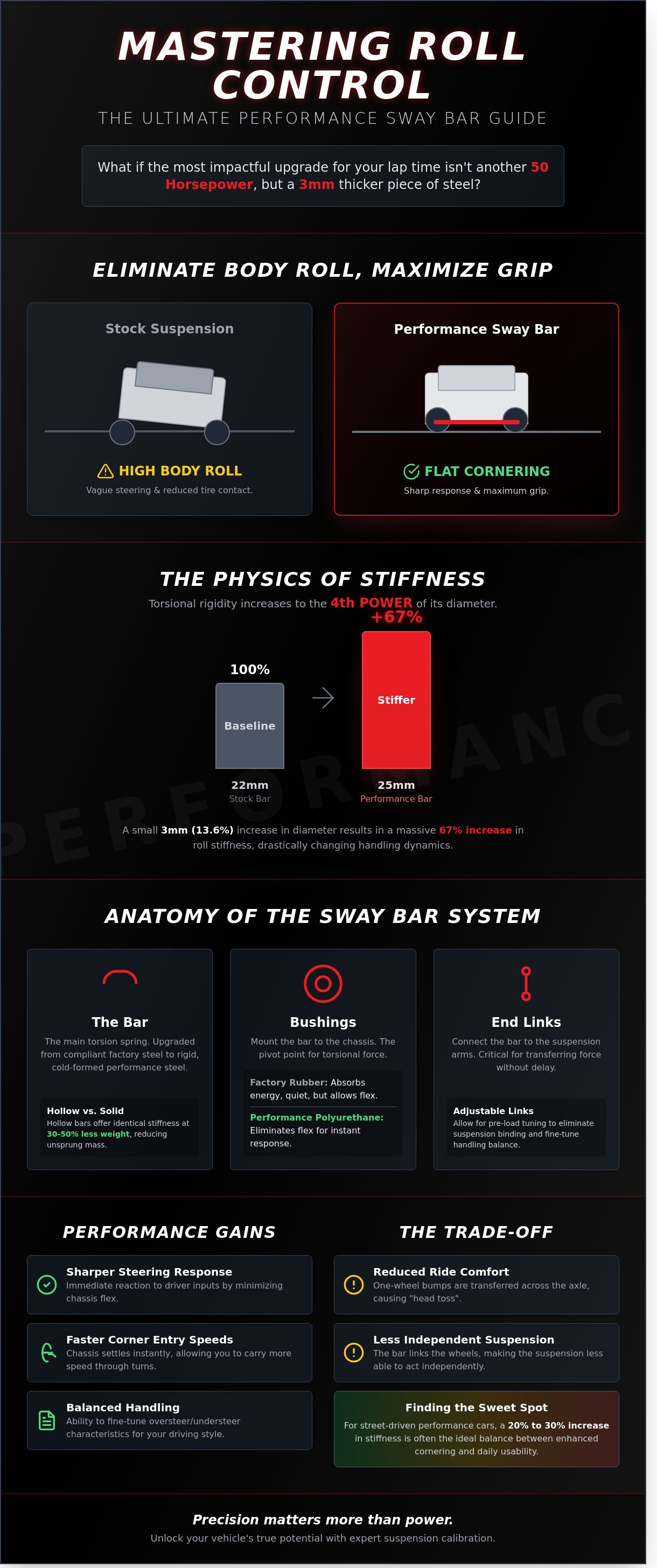
OEM engineers design factory bars for maximum comfort. They use thinner diameters to mask road imperfections and provide a compliant ride. Performance-grade bars prioritize mechanical grip and flat cornering instead. Upgrading from a stock 22mm bar to a 25mm performance unit can increase roll stiffness by over 45% in specific European platforms. This reduces the "boaty" feel during rapid direction changes and keeps the tire contact patch flat against the pavement.
The Anatomy of the Sway Bar System
The system relies on three primary components to function effectively:
- The Bar: This is the main torsion spring. High-end manufacturers use cold-formed solid steel or aircraft-grade hollow steel to balance weight and rigidity.
- Bushings: These act as the mounting points to the chassis. While factory rubber bushings prioritize silence, performance polyurethane versions eliminate flex for sharper response.
- End Links: These are the critical connectors between the sway bar and the suspension arms. They must be rigid to ensure every millimeter of bar movement translates into roll resistance.
History Check: A Canadian Innovation
The technology behind modern handling traces its roots to Fredericton, New Brunswick. Stephen Coleman filed the first patent for an anti-roll device on April 22, 1919. His vision was to prevent the top-heavy cars of that era from tipping during sharp turns. While luxury pre-war vehicles were the first to adopt them, they've evolved into a mandatory safety standard. Modern SUVs with high centers of gravity depend on these bars more than ever. Without them, a simple moose test or emergency lane change at 80 km/h would likely result in a rollover rather than a controlled maneuver.
How Sway Bars Work: The Physics of Roll Stiffness
When you enter a high-speed corner, physics works against your lap times. Centrifugal force pushes your car’s mass toward the outside tires. This causes the body to lean, a phenomenon known as body roll. A sway bar functions as a transverse torsion spring to counteract this motion. It links the left and right suspension components, forcing them to work in sync during lateral acceleration.
As the outside suspension compresses, the bar twists. This torsional force pulls the inside wheel upward, effectively "clamping" the car down to the tarmac. The result is a flatter cornering attitude. By reducing lean, you keep the tire contact patches parallel to the road surface, maximizing grip where it counts. If you’re looking to refine your vehicle’s dynamics, our team provides expert suspension calibration for European performance models.
Understanding Torsion and Leverage
Stiffness isn't linear; it's exponential. The torsional rigidity of a bar increases to the fourth power of its diameter. Upgrading from a 20mm bar to a 22mm bar yields a 46% increase in stiffness, despite a small physical change. You also face the choice between solid and hollow designs. Hollow bars, often found in high-end kits for Porsche or BMW, can weigh 30% to 50% less than solid alternatives while maintaining identical roll resistance. The length of the lever arm, the section connecting the bar to the end links, also dictates performance. Shorter arms create a stiffer response by reducing the mechanical advantage the wheel has over the bar.
The Trade-off: Independent vs. Dependent Suspension
Adding a heavy-duty sway bar makes your independent suspension less independent. When one wheel hits a bump, the bar transfers that energy to the opposite side. This can degrade ride quality on harsh Canadian roads. In cities like Toronto or Montreal, where frost heaves are common, an excessively stiff setup causes the car to feel nervous. Precision tuning involves balancing these factors:
- One-wheel bumps: Stiffer bars increase "head toss" or side-to-side rocking.
- Traction limits: Too much roll stiffness can actually lift an inside wheel, reducing total grip.
- Daily usability: A 20% to 30% increase in stiffness is often the "sweet spot" for street-driven performance cars.
We see many drivers over-stiffen their rear bars in an attempt to rotate the car. This often results in snap oversteer. Engineering a balanced handling profile requires calculating the specific roll couple distribution for your chassis. It's about precision, not just raw thickness.
Performance Benefits: Handling, Balance, and Grip
Upgrading your sway bar translates to immediate dividends on the tarmac. When you dive into a corner at a circuit like Mont-Tremblant, you need the chassis to react instantly. Reducing body roll by 30% or more through a stiffer bar keeps the tire's contact patch flat against the pavement. This prevents the "boaty" feeling common in stock suspension setups. You'll notice faster entry speeds because the chassis doesn't spend 0.5 seconds settling before it starts to turn. It's about precision. A flatter car maintains its alignment geometry, preventing extreme suspension travel that often leads to unpredictable camber changes mid-corner.
Tuning for Understeer and Oversteer
Most factory vehicles, particularly front-wheel-drive platforms like the Volkswagen Golf GTI or Audi A4, are tuned for understeer from the factory. A stiffer rear bar helps the car rotate, effectively "waking up" the rear end and allowing for a more aggressive line. Conversely, a heavier front bar increases high-speed stability but can lead to "plowing" if the front tires are overwhelmed. MTX Performance experts often recommend a "Square Setup" for balanced platforms like the BMW M3. This involves matching front and rear stiffness to create a neutral car that follows your steering inputs with surgical accuracy.
Adjustable Sway Bars: The Professional Edge
Serious enthusiasts demand flexibility. Professional-grade bars often feature two or three mounting holes at the ends. Moving the end link closer to the bar's pivot point increases effective stiffness by approximately 15% to 25% per hole. This allows you to stiffen the car for a weekend track event and soften it for the daily commute on frost-heaved Canadian roads. If you've lowered your vehicle by 20mm or more, you'll need adjustable end links. These components eliminate "preload," ensuring the sway bar doesn't tension the suspension unevenly while the car is at rest. It's a small detail that separates a basic upgrade from a professional-grade suspension overhaul.
- Flatter Cornering: Higher driver confidence through reduced lateral lean.
- Crisp Response: Eliminates the delay between steering input and vehicle reaction.
- Geometry Preservation: Keeps tires in their optimal grip window during high-G loads.
- Custom Calibration: Adjustable holes allow for fine-tuning based on tire compound and track conditions.
When to Upgrade: Signs of Wear and Performance Gaps
Your factory suspension has a breaking point. When you push a precision machine like a BMW M-series or an Audi RS beyond its standard operating parameters, the stock sway bar often becomes the primary bottleneck. You'll hear the failure before you feel it. Squeaking during low-speed turns or a rhythmic clunking over driveway transitions usually signals that your bushings have hardened or cracked. If the steering feels "lazy" or disconnected on center, your end links are likely the culprit. Worn ball joints in these links create a dead zone where the car fails to respond to initial inputs.
Upgrading becomes a necessity once you've moved to high-performance tires. Stickier rubber increases lateral G-forces, which the soft factory bars weren't designed to manage. This results in a "wallowy" sensation where the body rolls excessively despite the tires having plenty of grip. While a professional-grade coilover kit can easily exceed C$3,500, a performance sway bar set typically ranges from C$500 to C$950. It's the most strategic first modification for any enthusiast looking to flatten cornering without the harshness of track-spec springs.
Diagnosing Sway Bar Issues
Visual inspections are your best tool. Look for rubber bushings that appear "pancaked" or show visible dry rot. In Canada, the 130,000 tonnes of road salt applied annually to Ontario roads alone can seize end link hardware in as little as four winters. Physically grab the bar near the mounting points and shake it. Any audible "click" or felt movement indicates the ball joints have developed play. Precision handling requires zero tolerance in these connections.
The Suspension Ecosystem
A performance bar is a force multiplier for your existing setup. It complements lowering springs by controlling the weight transfer those shorter springs can't handle alone. To extract 100% of the component's potential, swap factory rubber for 95A durometer polyurethane bushings. This change eliminates the "squish" that delays bar activation. Pair these with a strut tower bar to lock down chassis rigidity. This combination ensures your suspension geometry remains static even when pulling 1.0g on the skidpad.
Don't let a soft chassis limit your car's true potential on the road or track. Consult with the experts at MTX Performance to select the perfect sway bar rate for your specific build today.
Choosing the Right Sway Bar for Your Build
Selecting the perfect sway bar requires a precise balance between your driving environment and chassis goals. If your vehicle spends 90% of its time on Montreal or Toronto streets, a moderate 20% to 30% increase in stiffness provides flatter cornering without ruining ride quality. For dedicated track builds, look for 3-point adjustable bars that allow you to fine-tune oversteer and understeer characteristics on the fly. Elite brands like Whiteline and Cusco lead the industry because they engineer components specifically for a car's unique kinematics. Whiteline's signature powder-coated finish hides heavy-duty spring steel, while Cusco utilizes high-tension steel to minimize diameter while maximizing rigidity. Don't settle for universal kits. A vehicle-specific fitment ensures the bar clears subframes and exhaust piping with millimetre precision.
Solid vs. Hollow: Which is Right for You?
Weight management is crucial for modern performance. Hollow bars are often 30% to 50% lighter than solid alternatives, making them the standard for sports cars where unsprung weight matters. When comparing them, look at the "equivalent diameter." A 26mm hollow bar might provide the same torsional stiffness as a 22mm solid bar. Solid bars remain the go-to for heavy SUVs or high-load endurance racing where maximum material density prevents fatigue over thousands of high-G cycles. Choose hollow for agility; choose solid for ultimate durability under extreme stress.
The Canadian Advantage: Shipping and Logistics
Ordering performance parts from US-based retailers often leads to "sticker shock" at the door. You'll frequently face a 6.1% duty on auto parts plus brokerage fees that can add C$50 to C$150 to your total. Buying from MTX Performance eliminates these hidden costs. We ship directly from Canadian warehouses, ensuring your sway bar arrives in 2 to 4 business days rather than weeks. Our team understands the Canadian climate. We recommend hardware and bushings that survive salt-heavy winters without seizing or squeaking. You save money on shipping while gaining access to technical experts who know exactly how a Porsche or Audi behaves on local roads.
- Precision Fitment: Guaranteed clearance for OEM and aftermarket exhaust systems.
- Reduced Lead Times: Nationwide shipping from local hubs avoids customs delays.
- Expert Support: Technical advice tailored to Canadian road conditions and performance standards.
Master Your Vehicle’s Cornering Dynamics
Upgrading your suspension isn't just about aesthetics; it's about engineering a superior driving experience. A high-quality sway bar effectively reduces body roll by up to 30%, keeping your contact patches planted during aggressive cornering. By fine-tuning your roll stiffness, you gain the ability to dial in neutral handling and eliminate frustrating understeer. These components are essential for anyone seeking to shave seconds off their lap times or improve high-speed highway stability.
At MTX Performance, we specialize in these technical refinements. As an authorized dealer for industry leaders like Whiteline and Cusco, we ensure your build uses components tested to 100% of their structural limits. We support the Canadian enthusiast community with fast nationwide shipping from our local warehouses. You'll avoid the 6.1% duty fees typically associated with importing performance parts from the US, keeping more C$ in your pocket for your next modification. Don't let factory limitations dictate your confidence behind the wheel. It's time to transform your vehicle's dynamics with precision parts engineered for the elite.
Browse Whiteline and Performance Sway Bar Kits at MTX Performance
Frequently Asked Questions
Will a stiffer sway bar make my ride uncomfortable?
A stiffer sway bar won't significantly degrade your ride quality on straight roads. Since the bar only resists independent wheel movement, you'll only feel a 10% to 15% increase in stiffness when hitting a bump with a single wheel. On flat pavement, the car remains as comfortable as the factory intended while staying flat through high-speed corners.
Do I need to replace both the front and rear sway bars at the same time?
You don't need to replace both simultaneously, but doing so provides the most predictable handling balance. Many Audi and Volkswagen enthusiasts start with just a rear upgrade to reduce the 12% understeer typical of front-heavy platforms. For rear-wheel-drive builds like a BMW M3, a matched set ensures the chassis remains neutral under 1.0g of lateral force.
What is the difference between a sway bar and a strut bar?
A sway bar connects the left and right suspension components to control body roll during cornering. A strut bar connects the tops of the shock towers to prevent chassis flex. While a strut bar maintains alignment geometry, the sway bar is the primary tool for tuning the actual roll stiffness and handling balance of your vehicle.
Can I install a sway bar myself with basic tools?
You can complete 80% of rear sway bar installations in your driveway using a floor jack and a standard metric socket set. Most rear bars take about 90 minutes to bolt on. Front bars are often more complex and might require 3 to 4 hours of labor if the subframe needs to be lowered to clear the steering rack.
How much does a performance sway bar kit typically cost in Canada?
A high-quality performance sway bar kit in Canada typically costs between C$450 and C$950 depending on the vehicle application. Premium brands using 4130 chromoly steel often sit at the higher end of that range. If you're looking for a single rear bar for a hot hatch, expect to pay approximately C$325 plus applicable provincial taxes.
Why does my new sway bar squeak when I go over bumps?
Squeaking is almost always caused by dry polyurethane bushings that lack proper lubrication. These performance bushings require a specialized marine-grade lithium grease to stay silent. Statistics show that 90% of noise complaints disappear after applying a fresh layer of synthetic grease during the first 500 kilometers of the break-in period.
Do sway bars affect my car’s ride height?
Sway bars don't change your ride height because they exert zero vertical force when the car is level. Your springs and struts determine the 100% of the vehicle's static height. The sway bar only comes into play when the suspension compresses on one side, meaning your car keeps its aggressive stance without any unwanted lift.
What are sway bar end links and do I need to upgrade them too?
End links are the vital connectors that join the bar to your suspension's control arms. You should upgrade them because OEM links often use thin steel or plastic that fails under the 30% higher torsional loads of a performance bar. Adjustable links allow you to eliminate preload, ensuring your suspension geometry remains perfect even after lowering the car.