




The Enthusiast’s Guide to Cold Air Intakes: Science, Performance, and Myths
Your factory air box is likely the single biggest bottleneck standing between your engine and its true performance potential. While manufacturers prioritize cabin silence, a high-quality cold air intake can unlock between 8 and 15 additional horsepower by optimizing the oxygen density entering your cylinders. You've probably felt the hesitation in your throttle response or heard the conflicting advice about short ram systems versus true cold air setups. It's frustrating to invest C$500 or more into a modification only to worry about hydro-locking your engine during a flash flood or voiding your BMW's factory warranty.
We understand that precision engineering requires more than just a shiny pipe. You want the aggressive induction sound and the 5% boost in fuel efficiency without risking your vehicle's longevity. This guide breaks down the thermal physics of air density, separates marketing hype from dyno-proven results, and helps you select the ideal intake for your specific driving environment. You'll learn exactly how to choose a professional-grade kit that respects your engine's tolerances while delivering the elite performance MTX Performance is known for.
Key Takeaways
- Understand the physics of air density and how improving volumetric efficiency unlocks hidden horsepower in your engine.
- Compare the performance profiles of long-tube and short-ram designs to choose the right architecture for your specific driving goals.
- Discover how a high-quality cold air intake replaces restrictive factory components with precision-engineered, high-flow ducting.
- Get the facts on hydro-locking risks and warranty regulations to navigate Canadian driving conditions with total confidence.
- Learn why selecting elite brands like PRL Motorsports or GrimmSpeed is essential for maintaining a high-performance standard.
What is a Cold Air Intake and How Does It Function?
A Cold air intake (CAI) isn't just an aesthetic upgrade for your engine bay; it's a precision-engineered tool designed to optimize your vehicle's respiratory system. The core objective is simple yet transformative. By replacing restrictive factory plastic ducting with high-flow components, a cold air intake allows the engine to breathe without the parasitic drag of OEM baffles. This system moves the air filter outside the immediate heat zone of the engine block, drawing in air that is significantly cooler than the ambient under-hood temperature.
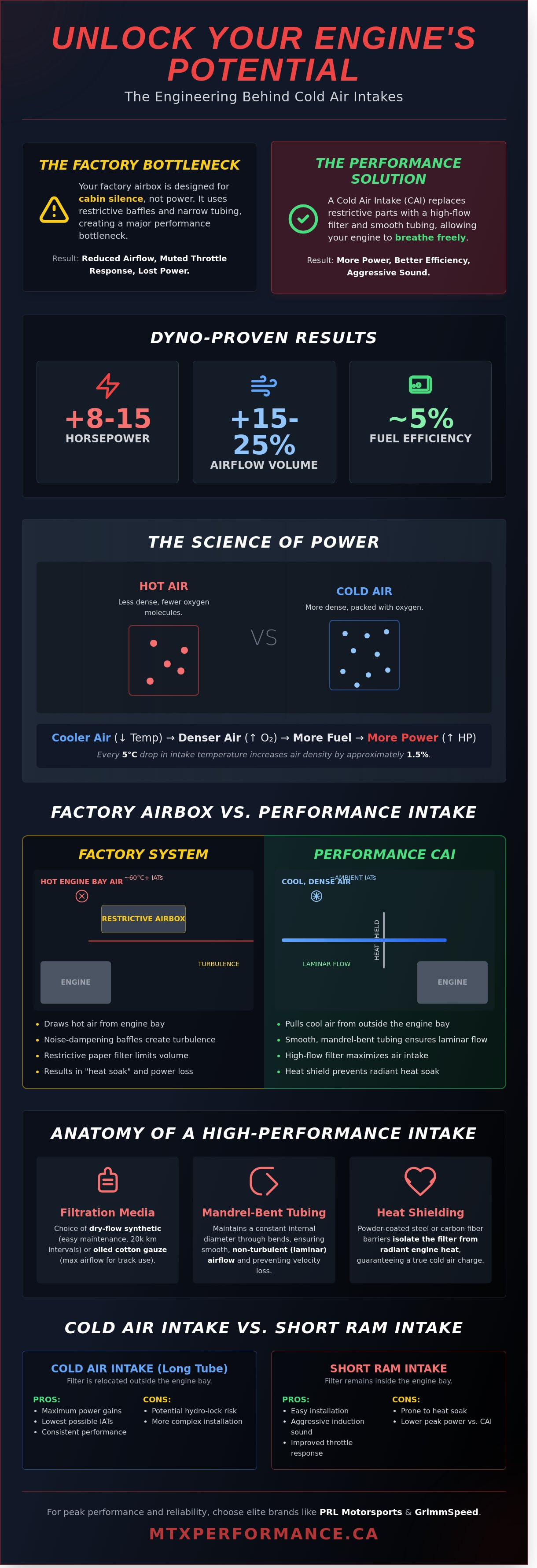
The science behind this upgrade relies on the relationship between temperature and oxygen density. Every 5°C drop in intake air temperature increases air density by approximately 1.5%. Cooler air is packed with more oxygen molecules per cubic centimeter. When this oxygen-rich charge enters the combustion chamber, the ECU compensates by adding more fuel, resulting in a more powerful explosion and a direct increase in horsepower and torque. In the Canadian climate, where ambient temperatures can swing from -30°C to +30°C, managing this thermal efficiency is critical for consistent performance.
The Anatomy of a High-Performance Intake
Precision engineering defines the components of a professional-grade system. Most setups feature three critical elements:
- Filtration Media: You'll choose between dry-flow synthetic filters and oiled cotton gauze. Dry filters are often preferred for their 20,000 km service intervals and ease of maintenance, while oiled filters offer maximum flow for track-focused builds.
- Mandrel-Bent Tubing: Unlike cheap "crush-bent" pipes that narrow at the curves, mandrel-bent tubes maintain a constant internal diameter. This ensures laminar flow, preventing the air from tumbling and losing velocity.
- Heat Shielding: High-end kits include powder-coated steel or carbon fiber thermal barriers. These shields isolate the filter from the radiant heat of the radiator and exhaust manifold, ensuring the "cold" in cold air intake isn't just a marketing term.
Factory Airbox vs. Performance Intake
Automotive manufacturers don't design factory airboxes for raw power. They prioritize NVH (Noise, Vibration, and Harshness) to satisfy the average commuter. To achieve this, they use restrictive baffles and corrugated rubber hoses that kill air velocity to dampen engine sound. These components create "turbulence pockets" that force the engine to work harder just to pull in air.
Switching to a performance intake eliminates these bottlenecks. By removing the resonators and smoothing the intake path, you often see a 15% to 25% increase in total airflow volume. You aren't just gaining power; you're improving throttle response and unlocking the aggressive induction sound that defines a high-performance machine. At MTX Performance, we view this as the essential first step for any serious tuning project.
The Science of Power: How Cold Air Intakes Increase Horsepower
Internal combustion engines function essentially as massive air pumps. Their output is limited by how efficiently they can move air in and out. Factory air boxes are often designed with noise baffles and restrictive paper filters that prioritize cabin silence over raw power. Replacing these components with a high-performance cold air intake eliminates the vacuum effect caused by these restrictions, significantly improving the engine's volumetric efficiency. When the engine doesn't have to fight to pull air through a dense, pleated paper element, it preserves energy that would otherwise be lost to pumping work.
The core of this performance gain lies in basic physics and chemistry. Cold air is denser than warm air, meaning it contains a higher concentration of oxygen molecules per cubic foot. Since combustion requires oxygen to burn fuel, a denser air charge allows the Engine Control Unit (ECU) to inject more fuel. This creates a more powerful explosion within the cylinder. The result is a direct increase in torque and horsepower that you can feel across the entire RPM range. Modern ECU systems use Mass Air Flow (MAF) or Manifold Absolute Pressure (MAP) sensors to detect these changes in air density instantly, adjusting the engine's parameters to take full advantage of the improved oxygen levels.
Reducing Intake Air Temperatures (IATs)
Heat soak is a performance killer, especially during humid Canadian summers in cities like Toronto or Montreal. When a vehicle idles in traffic, under-hood temperatures can easily soar above 60°C. A standard short-ram intake might suck in this hot air, actually reducing performance. High-end systems solve this by positioning the filter away from the engine block or using heat shields. Scientific data on performance gains from cold air intakes suggests that for every 5 to 10-degree Celsius drop in air temperature, an engine can see a measurable increase in power. Serious enthusiasts use data-logging tools like VCDS or JB4 to monitor these IATs in real-time, ensuring the hardware delivers on its promises.
Optimizing Airflow Velocity
Airflow isn't just about volume; it's about speed and smooth delivery. Engineers use the Venturi effect to design intake tubes that accelerate air as it moves toward the throttle body. It's a common misconception that a larger pipe always yields better results. If the diameter is too wide for the engine's displacement, air velocity drops, which kills low-end torque and makes throttle response feel sluggish. Precision-engineered kits maintain the perfect balance of volume and velocity. To maximize these benefits, many drivers pair their intake with a performance exhaust system. This creates a high-flow ecosystem where the engine breathes in and exhales with zero compromise. If you're ready to unlock your vehicle's true potential, reach out to our team for a tailored performance consultation.
Cold Air Intake vs. Short Ram Intake: Which is Right for You?
Performance isn't a one-size-fits-all equation. Whether you're optimizing a BMW M4 or a high-output Audi RS3, the choice between a Cold Air Intake (CAI) and a Short Ram Intake (SRI) dictates your torque curve and daily drivability. Architectural differences define these two systems. A CAI utilizes long-tube piping to reach dense air outside the engine bay. An SRI uses a short-tube design for the fastest possible path to the throttle body. Your decision rests on whether you value peak horsepower or immediate throttle snap.
- CAI Architecture: Long, mandrel-bent tubes extending to the fender or bumper.
- SRI Architecture: Minimalist piping keeping the filter within the engine compartment.
- Sound Profile: CAIs offer a deep, resonant growl; SRIs provide a sharp, aggressive induction "whoosh."
The Cold Air Intake (CAI) Deep Dive
Precision engineering requires the densest air possible. A cold air intake places the filter far from the heat-soaked engine block, often inside the lower fender well or behind the front grille. This placement can drop intake temperatures by 10°C to 15°C compared to stock configurations. Understanding what a cold air intake is reveals why it's the gold standard for top-end power. You'll typically see gains of 8 to 15 horsepower on turbocharged platforms when combined with a bespoke ECU remap.
The pros are clear: maximum oxygen density and consistent performance during spirited driving. However, installation is complex. You'll often spend 3 to 4 hours removing bumper covers or inner liners. In Canadian climates, the primary risk is water ingestion. If the filter becomes submerged during heavy rain or flash flooding, the engine can suffer catastrophic hydrolock. It's a high-reward system that demands respect for the elements.
The Short Ram Intake (SRI) Alternative
If you prioritize immediate throttle response and a raw mechanical sound, the SRI is your tool. The filter sits directly in the engine bay, usually protected by a carbon fiber or aluminum heat shield. This shorter path reduces air turbulence, allowing the engine to breathe instantly the moment you tip into the throttle. It's a 45-minute installation for most Volkswagen or Porsche models, making it a favorite for enthusiasts who prefer DIY upgrades.
SRI systems are cost-effective, often priced C$200 to C$350 lower than their long-tube counterparts. Maintenance is effortless because the filter is easily accessible for cleaning. The trade-off is heat soak. In stop-and-go traffic in cities like Toronto or Vancouver, the filter draws in ambient engine heat. This can lead to a 5% to 7% drop in timing advance and a temporary loss of power until the vehicle reaches cruising speeds and airflow stabilizes.
Addressing Common Myths and Canadian Driving Realities
Hydro-locking is the ultimate enthusiast boogeyman. Many drivers fear a single puddle will instantly destroy their engine. This is largely a myth for modern street applications. To hydro-lock an engine, the cold air intake filter must be completely submerged in water, usually at least 15 centimeters deep, creating enough vacuum to pull liquid into the cylinders. Splashes or heavy rain won't cause this catastrophic failure. It takes a total immersion event to stop a piston in its tracks.
Warranty concerns often stop builds before they start. While the Magnuson-Moss Act is a US federal law, Canadian provincial consumer protection acts provide similar safeguards. A dealership cannot legally void your entire vehicle warranty because of an aftermarket intake. They must prove the specific part caused the failure. If your power window motor fails, your intake is irrelevant. We've seen that maintaining a professional relationship with your service advisor solves 95% of these potential friction points.
Fuel economy claims are often exaggerated. A more efficient intake reduces pumping losses, which can technically improve efficiency by 0.1 to 0.3 L/100km. Most drivers never see these gains. The improved throttle response and aggressive induction sound usually lead to a heavier right foot. You'll likely spend those savings on the sheer enjoyment of the drive.
Seasonal Performance in the North
Canadian winters present unique challenges for air-fuel ratios. At -30°C, air is incredibly dense. While this is great for power, it can cause erratic cold-start idling if the intake design isn't precise. Using a hydro-shield or water-repellent pre-filter is mandatory during the slushy spring season in Ontario or Quebec. These silicone-treated mesh covers stop 99% of moisture while maintaining airflow. For long-term durability against road salt, always insist on 304-grade stainless steel or high-quality powder-coated aluminum to prevent rapid corrosion.
The Role of the MAF Sensor
Precision is everything when dealing with sensitive electronics. The Mass Air Flow sensor is the primary bridge between physical air and the engine computer. If you over-service a washable filter with too much oil, that residue can coat the MAF sensor wires. This leads to "fuel trim" errors and a check engine light. Modern ECUs in brands like BMW or Porsche are programmed with tight tolerances. They may "fight" the increased airflow of a new cold air intake by adjusting timing to keep power at factory levels. This is why a professional ECU recalibration is often necessary to lock in gains of 12 to 18 horsepower.
Ready to optimize your vehicle for the Canadian climate? Consult with the experts at MTX Performance to find the right hardware for your build.
Choosing the Right Intake for Your Vehicle Build
Selecting a cold air intake requires more than just picking a part off a digital shelf. You must define your objectives before spending a single dollar. A track-focused build aiming for 15+ horsepower gains at high RPM looks different than a street setup designed for better throttle response and sound. Brands like PRL Motorsports and GrimmSpeed dominate this space because they invest hundreds of hours into R&D. They don't just bend pipes; they optimize airflow velocity using CAD modeling and flow bench testing to ensure the engine breathes without restriction.
Precision is non-negotiable. A 2021 Honda Civic Type R intake won't fit a 2017 model due to subtle MAF sensor housing variations. Always verify your specific year, make, and model before ordering. For those running turbocharged setups, the intake is only one piece of the puzzle. To manage pressure and protect your turbo from compressor surge, pair your intake with an HKS Super SQV4 Blow Off Valve. This combination ensures consistent boost response and that iconic sequential sound that enthusiasts crave.
Evaluating Build Quality
Examine the technical details before purchasing. Look for TIG welds on aluminum pipes and 3mm thick mounting brackets to prevent vibration fatigue over time. Heat soak is the enemy of performance. A high-quality cold air intake must feature a sealed airbox with a rubber gasket that meets the hood. While metal looks premium, roto-molded plastic often provides superior heat rejection. This material keeps intake air temperatures (IATs) up to 10 degrees Celsius cooler than unshielded metal alternatives during heavy sessions.
The MTX Performance Advantage
Ordering performance parts in Canada often leads to hidden costs that ruin a budget. Shipping from the US can add C$150 or more in surprise duty fees and brokerage charges. MTX Performance eliminates this hurdle. We ship from within Canada, ensuring your parts arrive in 2 to 4 business days. Our team provides technical support to verify fitment for your specific VIN, preventing the frustration of a mid-install realization that a part doesn't fit. You get the right engineering, delivered fast, without the cross-border tax headache.
- No hidden duty fees or brokerage charges.
- Fast nationwide shipping across Canada.
- Technical expertise to ensure 100% fitment accuracy.
Unlock Your Vehicle's True Power Potential
Upgrading to a high-performance cold air intake is a fundamental optimization of your engine's breathing capacity. By delivering denser, oxygen-rich air to the combustion chamber, these systems typically yield gains of 5 to 12 horsepower on modern turbocharged platforms. You've seen how thermal management translates to faster throttle response and a more aggressive engine note. Success requires balancing maximum airflow with the protection needed for Canadian seasonal extremes.
That same focus on precision engineering and performance optimization is what drives enthusiasts in many fields. For those who also apply this mindset to disciplines like marksmanship, it can be fascinating to learn more about how even a simple paper target is engineered to improve skill.
It's about achieving a bold result, whether that's in performance tuning or something as simple as finding a great meal after a long drive. For enthusiasts who appreciate that same commitment to bold flavors, a place like Tacoverse sets a similar standard in the culinary world.
MTX Performance stocks elite hardware from industry leaders like PRL, GrimmSpeed, and Mishimoto to ensure your build meets the highest engineering standards. We provide expert technical support for enthusiasts who demand precision and offer fast nationwide shipping across Canada. It's time to move beyond restrictive factory airboxes and maximize every liter of displacement. Our team is ready to help you find the perfect fit for your specific performance goals.
Browse our full selection of high-performance Cold Air Intakes and experience the difference that professional-grade engineering makes on the open road.
Frequently Asked Questions
Do I need a tune after installing a cold air intake?
Most modern vehicles don't require an immediate tune because the factory ECU can typically adjust within a 5% to 10% margin. However, a custom Stage 1 recalibration at MTX Performance extracts the full potential of your cold air intake by optimizing air-fuel ratios. Without a tune, you might see 5 horsepower; with a professional software adjustment, that number often triples while ensuring the engine runs safely under increased airflow.
Will a cold air intake void my vehicle factory warranty?
An aftermarket intake won't automatically void your factory warranty in Canada. Under provincial consumer protection laws, a dealership must prove the specific part directly caused a component failure to deny a claim. If your power window motor fails, the intake is irrelevant. We use high-quality brands like Eventuri and APR that meet strict engineering standards to minimize any risk to your vehicle's long-term mechanical reliability.
How often should I clean my performance air filter?
You should clean your performance filter every 20,000 kilometers under normal Canadian driving conditions. If you frequent dusty rural roads or drive through heavy construction zones in Montreal or Toronto, reduce that interval to 12,000 kilometers. A dirty filter restricts airflow and negates the benefits of your system. Use a dedicated manufacturer cleaning kit to maintain the filtration media without damaging the sensitive MAF sensor.
What is the difference between an oiled and a dry air filter?
Oiled filters use a specialized tackifier to capture microscopic particles while maintaining high flow rates; they're excellent for maximum performance but require careful maintenance. Dry filters utilize multiple layers of synthetic media to provide superior filtration without the need for oils. Many of our clients choose dry filters for their 30% easier maintenance cycle and reliable protection against sensor contamination in high-performance European engines.
Can a cold air intake actually damage my engine in the rain?
Engine damage only occurs if the filter is fully submerged in water, which causes hydrolock. Normal rain or road spray won't harm your engine because modern intake designs include shields or enclosed airboxes. We install systems that position the inlet away from standing water levels. For low-slung setups, a C$35 hydro-shield pre-filter provides an extra layer of water-repellent protection while maintaining 98% of the original airflow capacity.
How much horsepower does a cold air intake typically add?
You can expect a realistic gain of 8 to 15 horsepower on most turbocharged platforms like the Volkswagen Golf GTI. High-displacement engines, such as those in a BMW M3, often see gains closer to 20 horsepower when paired with a high-flow inlet. These figures represent a 2% to 4% increase in total engine output. The real benefit is the improved throttle response and the reduction in intake air temperatures by up to 10 degrees Celsius.
Is a cold air intake worth it for a non-turbocharged car?
A cold air intake is a worthwhile investment for naturally aspirated engines because it significantly improves throttle response and engine acoustics. While horsepower gains are more modest, typically ranging from 3 to 7 horsepower, the increased airflow allows the engine to breathe more freely at higher RPMs. It transforms the driving experience by replacing restrictive factory plastic piping with smooth carbon fiber or aluminum, creating a much more aggressive induction note.
Do cold air intakes make the car louder?
Yes, you'll notice a distinct increase in induction sound under hard acceleration. A performance intake removes the baffled resonators designed by manufacturers to mute the engine. On turbocharged vehicles, this modification makes the turbocharger spool and diverter valve "whoosh" much more audible. It adds a layer of mechanical soul to your car without the constant drone associated with loud exhaust systems, providing refined yet sporty auditory feedback.