




Radium Engineering Dual Catch Can Kit: The Ultimate Engine Protection Guide for 2026
Your high-performance direct injection engine is effectively breathing its own waste, and by the 40,000 kilometer mark, that oily mist often transforms intake valves into a restricted, carbon-crusted mess. You didn't invest in a precision machine like a BMW M-series or a Porsche 911 to let sludge rob you of 15 horsepower. You already know that true performance isn't just about the peak numbers on a dyno; it's about the technical integrity of every internal component. Integrating a radium engineering dual catch can kit is the definitive solution to intercept these contaminants before they ever touch your intake tract.
We've seen how blow-by gases compromise even the most meticulous builds. This guide breaks down the mechanics of PCV and CCV systems so you can finally stop guessing which hose goes where. You'll discover why Radium Engineering remains the gold standard for elite tuners in 2026 and how to secure these premium parts right here in Canada. We'll show you how to protect your investment while avoiding the sting of C$150 surprise import fees, ensuring your engine remains as clean as the day it left the factory.
Key Takeaways
- Understand why the radium engineering dual catch can kit is essential for total engine protection, filtering both the PCV and CCV circuits simultaneously.
- Learn how to prevent octane degradation and maintain peak combustion efficiency by eliminating oil and moisture from your intake tract.
- Identify the technical advantages of 6061-T6 aerospace-grade aluminum and integrated dipsticks over inferior plastic or thin-wall steel alternatives.
- Get expert insights on installing and maintaining your filtration system to withstand the rigors of the Canadian climate and high-performance driving.
- Discover how to optimize your build’s budget by sourcing Radium Engineering components locally in C$ to eliminate hidden duty fees and international shipping stress.
What is a Radium Engineering Dual Catch Can Kit?
A radium engineering dual catch can kit is a professional-grade filtration system designed to intercept oil vapor and moisture before they contaminate your engine's intake tract. Since its inception in 2010, Radium Engineering has dominated the fluid management niche by prioritizing technical precision over simple aesthetics. This specific "dual" configuration is critical because it monitors both the PCV (Positive Crankcase Ventilation) and CCV (Crankcase Ventilation) sides of the engine. While a single can might catch some mist, a dual setup ensures that every vent point remains clean, protecting your high-performance investment from the inside out.
Understanding What is an Oil Catch Can? starts with recognizing the limitations of factory hardware. High-performance platforms like the BMW M3, Audi RS3, or Porsche 911 rely on direct injection (DI) and turbocharging. These engines don't have fuel spraying over the intake valves to wash away contaminants. Without a proper kit, these expensive components become coated in thick sludge within 25,000 kilometers of spirited driving. For Canadian drivers facing extreme temperature swings, this buildup happens even faster due to increased condensation during cold starts.
The Problem: Blow-by and Carbon Buildup
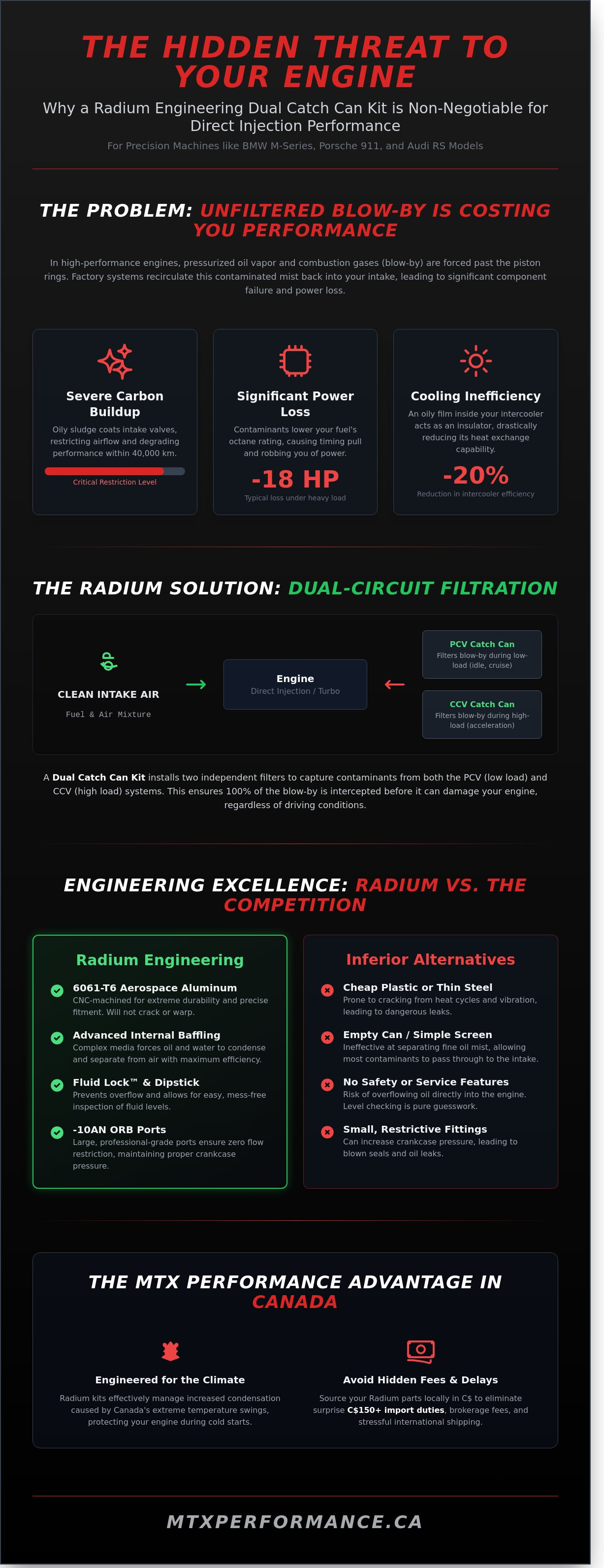
High cylinder pressures in turbocharged engines force a mixture of combustion gases and oil mist past the piston rings. This phenomenon, known as blow-by, creates a pressurized, "dirty" atmosphere inside the crankcase. Standard factory systems recirculate this mess back into the intake to meet emissions standards. Over time, this oil coats the intercooler core, reducing cooling efficiency by as much as 18 percent, and creates stubborn carbon deposits on intake valves. When you increase boost levels beyond factory specifications, the volume of blow-by often exceeds what the stock breather system can manage, leading to power loss and potential knock.
The Radium Solution: Fluid Lock Technology
Fluid Lock is a proprietary safety mechanism that prevents the reservoir from overflowing and sending raw oil into the engine if the can reaches its maximum capacity. Unlike cheap, empty canisters found on discount websites, Radium units feature intricate internal baffling that forces air to change direction rapidly, separating oil droplets from the air stream with surgical precision. The radium engineering dual catch can kit utilizes 10AN ORB ports to maintain unrestricted flow, ensuring your crankcase breathes freely even under maximum load. This isn't just a dress-up part; it's a vital piece of insurance for any built engine operating in Canada's demanding climate. Every component is machined from 6061-T6 aluminum, reflecting the elite engineering standards that MTX Performance clients expect.
Why Two is Better Than One: The Dual-Can Advantage
A single catch can is a half-measure that leaves 50% of your engine's breathing system vulnerable. The radium engineering dual catch can kit provides a comprehensive solution by isolating the two distinct paths blow-by gases take. By installing two independent cans, you ensure that oil vapors never reach the intake tract, regardless of whether you're stuck in Toronto traffic or hitting the redline at Calabogie Motorsports Park. This dual-circuit approach is essential for preventing octane degradation. When oil mist mixes with your air-fuel charge, it effectively lowers your fuel's knock resistance. For a tuned engine running on 94 octane, even a small amount of oil contamination can trigger timing pull, reducing power output by as much as 12 to 18 horsepower under heavy load.
Beyond combustion, protecting the cooling hardware is paramount. Oil film acts as an insulator. A thin coating inside your intercooler can reduce heat exchange efficiency by 20% based on recent thermal testing of forced induction systems. The radium engineering dual catch can kit maintains factory pressure strategies while ensuring that only clean, oil-free air enters the turbocharger and intake manifold. This setup uses independent plumbing for each side, meaning the system doesn't interfere with the sensitive pressure sensors found in modern European performance cars.
The PCV Side: Low-Load Protection
The Positive Crankcase Ventilation (PCV) side operates under high vacuum conditions, such as idling or cruising at 100 km/h on the highway. During these phases, the engine draws vapors directly into the intake manifold. Without filtration, this leads to significant carbon build-up on the intake valves, a notorious issue for GDI engines that can cost upwards of C$700 for a professional walnut blasting service. Radium integrates a high-quality check valve in this line. This component prevents boost pressure from leaking back into the crankcase, maintaining a closed-loop system that exceeds OEM reliability standards.
The CCV Side: High-Load Protection
When you transition to wide-open throttle (WOT) and boost levels climb toward 24 PSI, the PCV valve closes and the Crankcase Ventilation (CCV) side takes over. This "fresh air" side vents toward the turbocharger inlet. Single-can systems often ignore this path, allowing oil to coat the turbo compressor wheel. This leads to blade erosion and fouled intercoolers over time. By filtering this atmospheric side independently, Radium ensures the entire intake tract remains pristine during high-stress maneuvers. If you're looking to maximize your build's longevity, you can browse our precision hardware to find the perfect kit for your specific platform.
Engineering Excellence: Radium vs. The Competition
Choosing a radium engineering dual catch can kit represents a shift from basic maintenance to elite engine protection. Most entry-level competitors rely on plastic housings or thin-wall steel that warps under the intense thermal cycles of a high-performance engine bay. Radium rejects these compromises. They utilize CNC-machined 6061-T6 aluminum for every canister. This material ensures the units maintain structural integrity even when engine bay temperatures exceed 100°C during track sessions or heavy towing.
Serviceability is where Radium truly pulls ahead of the pack. Each kit features an O-ring sealed dipstick, allowing you to check fluid levels in under 10 seconds without any tools. For owners who prioritize efficiency during maintenance, the modular design supports optional petcock drain kits. This upgrade allows you to empty the cans directly into a waste container during an oil change, eliminating the need to unmount the hardware. The type II anodized finish isn't just for aesthetics; it provides a rugged barrier against the corrosive road salts common in Canadian winters and harsh engine degreasers.
Internal Baffling and Filtration
Effective oil separation requires precision engineering, not just an empty reservoir. Radium employs a sophisticated two-step process. Initial separation occurs through condensation as hot vapors hit the cold aluminum walls. Remaining contaminants are then caught by a stainless steel filtration media. This technical approach is superior because it avoids the use of restrictive steel wool. Cheap wool can break apart over time, potentially sending metal shards into your turbocharger or cylinders. Wikipedia explains the function of an oil catch can as a method to prevent oil re-entry into the intake, and Radium’s high-volume design ensures this happens without sacrificing flow, even in builds pushing 700+ horsepower.
Fitment: Universal vs. Vehicle-Specific
Radium offers a level of versatility that fits any project. Their universal mounting brackets provide 360-degree rotation, making them the top choice for custom builds. However, for platforms like the Subaru STI or Toyota GR86, their vehicle-specific kits offer a "factory-plus" look with laser-cut brackets. These kits often work in synergy with other high-end breathing mods. Pairing a catch can with a PRL Motorsports High Volume Intake ensures that the cold, dense air your intake provides isn't immediately diluted by oily crankcase gasses. It is a complete ecosystem of performance and longevity for the serious Canadian enthusiast.
Installation and Maintenance in the Canadian Climate
Installing the radium engineering dual catch can kit requires technical precision to ensure the system handles the extreme thermal cycles of the Canadian climate. The workflow begins with identifying the vehicle-specific mounting points, usually located on the strut tower or near the radiator support. Proper plumbing is the most critical step. You must route the lines to avoid sharp bends that could kink under heat or restrict flow. Secure every hose with P-clamps or high-quality nylon ties to prevent vibration wear against other engine components. We recommend using only PCV-rated reinforced rubber or stainless steel braided hoses. Standard vacuum lines will collapse under the high vacuum pressures found in modern turbocharged engines, especially when ambient temperatures fluctuate between 30°C in summer and -30°C in winter.
The "Winter Freeze" is a legitimate concern for drivers in provinces like Alberta or Quebec. When oil mist mixes with water vapor, it creates a thick, milky emulsion. In sub-zero temperatures, this mixture can freeze and block the PCV system entirely. A blocked line leads to crankcase pressure spikes that can blow out main seals or dipsticks. To mitigate this, we route lines close to the engine block to utilize radiant heat and keep the fluids in a liquid state. Your draining frequency depends entirely on your driving style and the season. While a summer track day might require a check every 200km, daily winter commuting in the GTA often necessitates draining every 1,500km due to increased moisture accumulation.
Cold Weather Best Practices
Condensation levels skyrocket during Canadian winters. Every cold start produces water vapor that the radium engineering dual catch can kit must capture. You should check the integrated dipsticks every 1,000km once temperatures stay below zero. Ensure your hoses are not positioned in "cold spots" directly behind the front grille where they are hit by freezing air. Keeping the lines insulated or tucked away from direct wind blast prevents the emulsion from reaching a solid state, ensuring your engine breathes freely even in January.
The Maintenance Checklist
Maintaining your Radium system is straightforward but essential for long-term reliability. Follow this professional protocol to keep your engine protected:
- Unscrew the Reservoir: Radium cans feature a two-piece design. Unscrew the bottom half by hand. You don't need to disconnect the lines, which prevents wear on the fittings.
- Clean the Mesh: Every 15,000km, remove the internal stainless steel filtration media. Soak it in a solvent like brake cleaner to dissolve carbon deposits and varnish.
- Inspect O-Rings: Check the Viton O-rings for signs of flattening or cracking. Apply a light coat of silicone grease to maintain the seal.
- Fluid Disposal: Dispose of the captured fluids at a certified oil recycling center. This mixture is a toxic blend of fuel, water, and oil.
Protecting Your Build with MTX Performance
Ordering your radium engineering dual catch can kit from MTX Performance is a strategic decision for your vehicle's longevity. We eliminate the friction of international logistics. You avoid the "Duty Trap" entirely. When you order from US-based retailers, you often face surprise brokerage fees and import duties that can add 15% to 25% to your final cost. Our Ontario-based warehouse ensures that the price you see is the price you pay in C$. You won't deal with the volatility of the CAD to USD exchange rate or wait weeks for customs clearance. We've seen enthusiasts save upwards of C$150 on shipping and administrative fees alone by choosing a domestic partner.
Our team consists of experts who live for high-performance engineering. We understand the specific demands of the Canadian climate, from sub-zero winters to grueling track days in July. This local expertise means we provide technical support tailored to your specific environment. We ship nationwide with precision. Most orders reach major hubs like Toronto, Montreal, or Vancouver within 2 to 3 business days. This minimizes your vehicle's downtime and gets your project back on the lift faster. We treat every order with the respect a high-end build deserves.
Complete Your Performance Package
A high-quality oil management system is a mandatory prerequisite for aggressive software upgrades. If you're running Unitronic performance tuning, your engine experiences significantly increased crankcase pressure. The radium engineering dual catch can kit captures oil vapor before it coats your intake valves, maintaining the efficiency of your tune and preventing power-robbing carbon buildup. It's the baseline for any serious power increase in 2026.
Engine protection is only one half of the performance equation. True driving dynamics require a balanced chassis. We recommend pairing your engine safeguards with precision handling upgrades. Consult our Suspension Torsion Bar Guide to see how refined suspension geometry complements a high-output powertrain. A fast car is useless if it can't put the power down effectively through the corners.
Don't leave your engine's health to chance. Secure your investment with the industry standard in oil separation technology. Protect your build with the experts who understand the Canadian performance landscape. Order your Radium kit today and experience the MTX Performance standard of excellence.
Defend Your Engine with Precision Hardware
Protecting your high-performance engine requires more than basic maintenance. For 2026 builds, the radium engineering dual catch can kit stands as the industry standard for preventing heavy carbon buildup on intake valves. By capturing oil vapor from both the PCV and crankcase vent sides, this CNC-machined 6061-T6 aluminum system ensures blow-by is filtered before it can contaminate your combustion chamber. This isn't just a cosmetic upgrade; it's a critical safeguard for GDI engines that often face C$800 valve cleaning bills every 40,000 kilometers.
MTX Performance delivers this elite hardware directly to your shop without the headache of international logistics. We provide 2-4 day nationwide Canadian shipping and eliminate all cross-border duty fees, saving you over C$100 in hidden import costs on every order. Our team provides expert technical support to ensure your installation meets the rigorous standards your vehicle demands. Don't leave your engine's health to chance. Shop Radium Engineering Dual Catch Can Kits at MTX Performance and give your vehicle the protection it deserves. Your build is a serious investment; it's time to help you defend every horsepower.
Frequently Asked Questions
Will a Radium dual catch can kit void my factory warranty?
Installing a Radium engineering dual catch can kit doesn't automatically void your entire factory warranty in Canada. Dealerships must prove the aftermarket part directly caused a specific failure to deny a warranty claim under provincial consumer protection laws. Most high-performance owners of BMW or Audi vehicles find that service centers respect these upgrades as preventative maintenance. You should keep your stock components if you need to revert the system for major powertrain inspections.
Can I install this kit myself or do I need a professional shop?
You can install this kit yourself if you have basic mechanical tools and roughly 3 hours of time. While Radium provides detailed instructions, professional installation at a specialized shop ensures perfect hose routing and leak-free connections. At MTX Performance, we often see DIY installs with pinched lines that restrict airflow. Professional labor for this service typically costs between C$250 and C$450 depending on your engine bay's complexity.
How is a catch can different from an Air Oil Separator (AOS)?
A catch can collects blow-by contaminants in a reservoir that you must manually drain; an Air Oil Separator returns that oil back into the crankcase. The Radium kit focuses on keeping those impurities out of your intake tract entirely to prevent carbon buildup on direct-injection valves. This is especially critical for Porsche or Volkswagen engines where carbon deposits reduce efficiency. Catch cans are often preferred because they don't require complex plumbing back to the oil pan.
Does the Radium kit vent to the atmosphere (VTA) or is it a closed system?
The Radium Engineering dual catch can kit is a closed-loop system designed to maintain vacuum and comply with Canadian emissions standards. It recirculates filtered air back into the intake rather than venting oily vapors to the atmosphere. This setup prevents unpleasant smells in the cabin and ensures your engine's mass airflow sensors receive accurate readings. Closed systems are the superior choice for street-driven performance cars to avoid potential fines and environmental impact.
What happens if I forget to drain my catch can?
If you forget to drain the reservoir, the collected fluid will eventually reach the internal baffle and get sucked back into the intake manifold. This defeats the purpose of the kit and can cause a sudden cloud of smoke or fouled spark plugs. We recommend checking the integrated dipstick every 5,000 kilometers or during every scheduled oil change. Most 2026 performance models collect about 50ml to 150ml of fluid between standard service intervals.
Is a dual kit necessary for a naturally aspirated (NA) engine?
A dual kit is highly beneficial for naturally aspirated engines because it monitors both the PCV and the crankcase vent (CCV) lines. High-revving NA engines from manufacturers like Porsche still produce significant blow-by during track use or aggressive street driving. Protecting both sides of the system ensures your intake valves stay 95% cleaner over the life of the vehicle. It's a small investment to maintain peak horsepower and crisp throttle response.
Can the catch can fluid be recycled with regular motor oil?
You shouldn't recycle catch can fluid with your regular motor oil because it contains a high concentration of fuel, water, and acidic combustion byproducts. This mixture has a much lower viscosity and higher acidity than the oil in your sump. Instead, collect the waste in a separate sealed container and take it to a local Canadian Tire or hazardous waste depot. Proper disposal protects the environment and follows local recycling regulations for automotive fluids.
What hose size does the Radium Engineering dual kit typically use?
Radium Engineering kits typically utilize 10AN (5/8 inch) or 3/8 inch PCV-rated hoses depending on the specific vehicle application. These hoses are reinforced to prevent collapsing under high vacuum and are resistant to long-term oil degradation. Using the correct diameter is critical; a hose that's 2mm too small can increase crankcase pressure and lead to gasket leaks. Always use the high-grade aluminum fittings included in the kit for a secure, professional seal.