




The Ultimate Guide to Catalytic Converters: Engineering, Performance, and Maintenance for 2026
Your catalytic converter isn't just a government-mandated filter; it's the single most restrictive bottleneck standing between your engine and its peak power output. It's understandable why many Canadian enthusiasts view this component with a mix of dread and frustration. Whether you're staring at a C$2,800 replacement quote for your BMW M-Series or worrying about the 25% rise in theft reported across major Canadian cities since 2023, the anxiety is real. You deserve a solution that prioritizes both environmental compliance and mechanical excellence.
We're here to turn that frustration into a competitive advantage. This guide gives you the technical blueprints to master the internal science of your emissions system, ensuring you never face a failed test or a hollowed-out exhaust. You'll learn exactly how to balance backpressure with flow to unlock hidden horsepower. We're diving deep into the engineering of precious metal substrates, the specific signs of thermal failure, and the critical performance differences between restrictive OEM units and 200-cell high-flow upgrades for 2026.
Key Takeaways
- Understand the precision engineering of your exhaust stream and how its core components transform toxic emissions into cleaner output.
- Learn how exotic metals like Palladium and Rhodium manage thermal "light-off" to maintain peak chemical efficiency and engine health.
- Master the diagnostics of a failing catalytic converter by deciphering "Check Engine" codes and identifying physical symptoms before they compromise performance.
- Compare High-Flow versus OEM specifications to find the perfect balance of backpressure reduction and Cells Per Square Inch (CPSI) for power gains.
- Navigate the Canadian performance market to secure top-tier components without the burden of international shipping delays or surprise C$ duty fees.
What is a Catalytic Converter? Understanding the Core of Your Exhaust System
A catalytic converter is much more than a simple filter in your exhaust pipe. It's a high-precision chemical reactor designed to neutralize the toxic byproducts of internal combustion. This device sits strategically between the engine manifold and the muffler, directly in the path of high-temperature exhaust gases. For owners of performance vehicles like Audi, BMW, or Mercedes-AMG, this component is the gatekeeper of both environmental compliance and engine health. It ensures that the raw power generated in the cylinders doesn't result in excessive environmental damage.
Since the early 1980s, the "Three-Way" catalyst has been the industry standard for gasoline engines. It manages three specific pollutants: carbon monoxide, nitrogen oxides, and hydrocarbons. In Canada, where provincial regulations require strict adherence to emissions standards, a functioning converter is non-negotiable. Beyond clean air, it plays a critical role in managing backpressure. A well-engineered converter ensures your engine breathes correctly, preventing power loss that can exceed 15 horsepower when a unit becomes restricted or clogged. At MTX Performance, we view this component as a vital link in the performance chain, balancing flow efficiency with chemical precision.
The Anatomy of an Exhaust Catalyst
The internal architecture is a marvel of materials science. It features a honeycomb substrate, typically made of cordierite ceramic or metallic foil, providing a massive surface area in a compact space. Most modern units feature 400 to 600 cells per square inch. This core is coated with a "washcoat" of aluminum oxide, which creates a porous foundation for the precious metals. The entire assembly is encased in a high-grade stainless steel shell. This housing is rated to handle extreme thermal expansion and temperatures that often spike above 900 degrees Celsius during aggressive driving sessions.
How the Conversion Process Works
The conversion happens in two distinct stages. First, the reduction catalyst uses platinum and rhodium to break down nitrogen oxide (NOx) into harmless nitrogen and oxygen. Second, the oxidation catalyst uses platinum and palladium to burn off carbon monoxide and unburned fuel. Your vehicle's O2 sensors act as the system's brain, monitoring oxygen levels before and after the catalytic converter. This data allows the ECU to make micro-adjustments to the fuel trim every few milliseconds, maintaining a conversion efficiency rate of nearly 99% when the system reaches its light-off temperature.
The Science of Clean Power: How Precious Metals Drive Performance
Inside every high-performance catalytic converter, a complex chemical dance occurs at the molecular level. Three rare earth metals drive this process: Platinum, Palladium, and Rhodium. Platinum and Palladium act as oxidation catalysts, stripping carbon monoxide and unburnt hydrocarbons from the exhaust stream. Rhodium handles the reduction side. These metals don't disappear during the reaction; they provide the physical site where molecules break apart and reform into less harmful substances. The efficiency of this process depends entirely on the "loading," which refers to the actual weight of precious metals applied to the internal substrate.
Thermal management dictates whether this chemistry actually works. Every converter has a specific "light-off" temperature, typically around 300°C (572°F). Until the unit reaches this heat, it's essentially a pass-through pipe for raw pollutants. In Canada, where winter temperatures frequently drop below -25°C, reaching light-off quickly is a major engineering challenge. High-end units utilize advanced wash-coats that maximize the active surface area, ensuring the reaction starts within seconds of ignition to protect both the environment and your engine's sensors.
The Chemistry of Exhaust Purification
The reduction catalyst specifically targets Nitrogen Oxides, breaking them down into harmless Nitrogen and Oxygen gas. The precious metal surface facilitates these reactions by lowering the required activation energy without being consumed in the process. Efficiency relies heavily on the engine's air-fuel ratio. If the mixture is too rich, the excess fuel can coat the catalyst and "smother" the reaction. Maintaining a precise Lambda 1.0 ratio ensures the chemistry remains balanced and the conversion rate stays above 98%.
Why Quality Materials Matter for Longevity
Performance vehicles demand more from a substrate than a standard commuter car. While entry-level converters use thin ceramic honeycombs, high-performance variants often utilize metallic substrates that withstand extreme thermal shock. This is vital for Canadian drivers who subject their vehicles to 800°C exhaust gas immediately followed by freezing slush. "Poisoning" is the primary killer of these units. Engine oil leaks or phosphorus from poor-quality additives can permanently coat the Platinum layers, rendering the device useless.
Structural integrity is the final piece of the puzzle. The internal substrate is held in place by a specialized intumescent matting. In low-grade units, high-vibration driving or aggressive anti-lag tunes can cause this matting to degrade. Once the substrate starts to rattle, it's only a matter of time before it shatters and blocks the exhaust flow entirely. Investing in a high-loading unit, which can range from C$1,100 to C$2,400 for European marques like Porsche or BMW, ensures the internal chemistry remains potent for over 150,000 kilometers. If you're feeling a loss in top-end power, it's worth scheduling a technical diagnostic session to check for substrate collapse or backpressure issues.
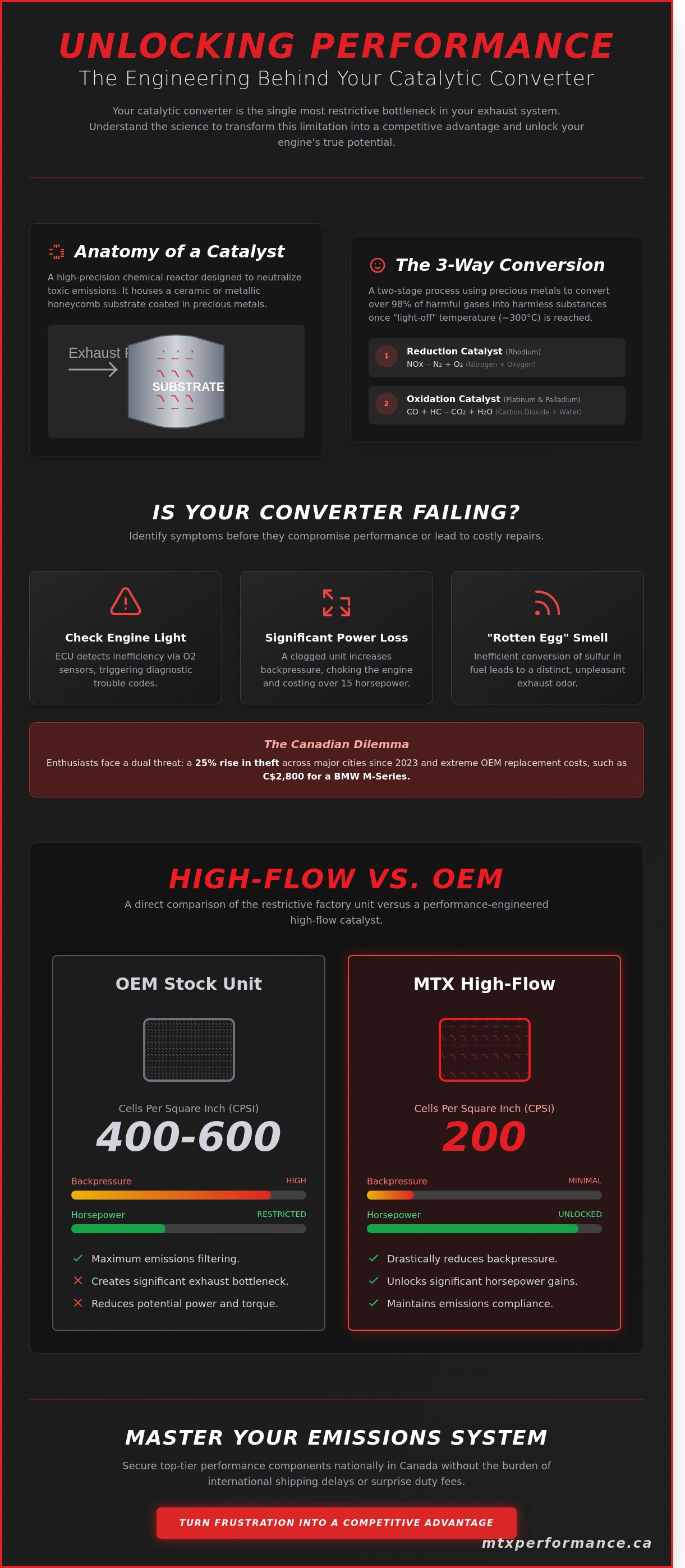
Engineered flow is a game of density. Standard OEM units usually feature 400 to 600 CPSI (cells per square inch). This provides massive surface area but creates significant backpressure. High-performance variants often drop this to 200 CPSI. This reduction in cell density increases exhaust velocity and improves throttle response while still providing enough surface area for the precious metals to do their job effectively.
Diagnosing Common Issues: Why Catalytic Converters Fail
Your vehicle's onboard diagnostics (OBD-II) system serves as the first line of defense. A P0420 or P0421 code indicates that the catalytic converter is operating below the 95% efficiency threshold required by modern emissions standards. These codes trigger when the oxygen sensors before and after the unit report nearly identical readings, signaling that the internal catalyst is no longer cleaning the exhaust stream. Beyond the dashboard, physical symptoms often manifest as a pungent "rotten egg" odor. This smell results from hydrogen sulfide failing to convert into odorless sulfur dioxide. If you hear a metallic rattling under the chassis, the internal ceramic monolith has likely shattered into fragments due to thermal shock or impact.
Performance degradation is the most frustrating symptom for any driving enthusiast. A failing converter creates immense backpressure, which can sap up to 25% of your engine's total output. You'll notice sluggish acceleration, a loss of high-end power, and a significant drop in fuel economy, often exceeding a 15% increase in consumption. In Canada, external threats are just as prevalent as mechanical failure. Catalytic converter theft has surged by over 60% in various provinces since 2022. Thieves target the precious metals inside, such as rhodium and palladium. Replacing a stolen unit on a high-performance European vehicle can easily exceed C$3,000, making protective shields or high-security marking kits a wise investment for 2026.
Signs Your Converter is Clogged or Melted
Internal melting occurs when unburnt fuel enters the exhaust, causing temperatures to spike above 1,200°C. This liquefies the substrate and blocks flow. You can diagnose this by performing a backpressure test at the oxygen sensor port; a healthy system should show less than 1.5 PSI at 2,500 RPM. For a quicker check, use a rubber mallet for a "tap test." If the unit rattles like a box of rocks, the internal structure is compromised and requires immediate replacement to avoid engine damage.
Preventative Maintenance for Your Exhaust System
Longevity starts with your ignition system. Faulty spark plugs or failing coils lead to misfires that dump raw fuel into the catalytic converter, destroying it in minutes. Use only high-quality engine oil with an API SP rating to prevent phosphorus poisoning of the catalyst. For those looking to optimize their entire setup, our Performance Exhaust Systems Guide details how to balance flow and filtration. Regular maintenance of your air filters and O2 sensors ensures the air-fuel ratio remains precise, protecting your expensive emissions components from premature wear.
High-Flow vs. OEM: Balancing Backpressure and Flow for Performance Gains
Standard OEM converters focus on one goal: meeting stringent Canadian emissions regulations. To achieve this, manufacturers use dense ceramic substrates that create significant backpressure. This resistance traps heat and slows down exhaust gas velocity. For a stock commuter, it's efficient. For a performance enthusiast, it's a bottleneck. A high-quality catalytic converter designed for high-flow applications removes this restriction while keeping your vehicle street-legal and environmentally responsible. OEM units are engineered for the masses; they prioritize maximum filtration over power. This creates a literal plug in your exhaust system. High-flow alternatives use metallic substrates instead of ceramic. Metallic cores are thinner and stronger, allowing for larger openings within the same physical diameter. This engineering shift reduces backpressure by up to 40% compared to stock units.
Optimizing the Exhaust Stream
The difference lies in CPSI (Cells Per Square Inch). Most factory units feature a 400 to 600 CPSI density. Performance units typically utilize a 200 CPSI metallic core. This 50% to 60% reduction in cell density allows the engine to breathe. When you integrate these components with Unitronic performance tuning, the results are immediate. The ECU adjustments work in tandem with the reduced backpressure to decrease turbo lag. You'll often see turbo spool-up occurring 300 RPM sooner than stock. The sound profile also shifts; expect a more resonant, aggressive tone that highlights the engine's natural timbre without the offensive rasp of a cat-less setup.
Avoiding the Dreaded Check Engine Light
Cheap "test pipes" or low-grade catalysts often trigger a Check Engine Light (CEL) because they can't effectively process exhaust gases. Premium high-flow units use advanced wash-coat technologies and precious metal loadings, including Platinum and Rhodium, to satisfy sensitive O2 sensors. This "no-CEL" reliability is crucial for daily drivers in Canada. These units pair exceptionally well with other bolt-ons like the PRL Motorsports High Volume Intake. By optimizing both the intake and exhaust sides, you create a synchronized flow path. On modern turbocharged platforms, this combination can yield dyno-proven gains of 20 to 30 horsepower. It's the professional way to build power without the smell of raw fuel or the legal headaches of removing emission controls. You get the performance of a track car with the civility required for Canadian streets.
Ready to unlock your vehicle's true potential? Upgrade your exhaust system with the experts at MTX Performance today.
Sourcing Quality Catalytic Converters Nationally in Canada
Securing a high-grade catalytic converter within Canada is a strategic move for any serious enthusiast. Buying domestic eliminates the financial volatility of international trade. When you order from across the border, you're often hit with "surprise" brokerage fees and duty charges that can add C$85 to C$210 to your final invoice. MTX Performance removes these variables by maintaining a deep inventory of elite brands right here. We stock components engineered for precision, ensuring that your BMW, Audi, or Porsche maintains its performance integrity without the 14-day wait at customs.
Verifying fitment is the most critical step before finalizing your purchase. A 2026-ready build requires exact alignment with your vehicle's engine code and oxygen sensor locations. We've seen generic "universal" parts fail to clear subframes or trigger immediate check-engine lights. Our team uses precise VIN-matching protocols to ensure every component integrates seamlessly with your existing exhaust architecture. This meticulous approach prevents the frustration of mid-installation delays and ensures your vehicle meets Canadian environmental standards without sacrificing horsepower.
Why Nationwide Shipping Matters for Heavy Exhaust Parts
Logistics for bulky exhaust assemblies demand a specialized approach. A typical high-performance catalytic converter assembly weighs between 12kg and 22kg. Shipping these items internationally isn't just expensive; it exposes the fragile internal substrate to prolonged handling risks. Our domestic shipping network is optimized for heavy goods, typically delivering to major Canadian hubs within 48 to 72 hours. This efficiency keeps your project on schedule and reduces freight costs by as much as 40% compared to international carriers. For those located near our primary distribution hub, local pickup options provide an immediate solution and a chance to consult directly with our technical experts.
Making the Right Choice for Your Build
Canadian road conditions are notoriously harsh on underbody components. The road salt and liquid brine used during our winters will compromise T409 stainless steel in as little as three seasons. We prioritize T304 stainless steel or high-nickel alloys that offer superior corrosion resistance. When you consult with our experts, we don't just look at a catalog; we analyze your specific performance goals, whether that's track-day heat management or daily-driver reliability. We verify that your chosen component carries a robust warranty that actually carries weight in the Canadian market. It's about building for longevity and power without compromise. Ready to upgrade? Browse our full selection of performance exhaust components and experience the difference that expert-led sourcing makes for your vehicle.
Maximize Your Machine’s Potential for 2026
Your vehicle's exhaust system is a precision-engineered circuit where every millisecond matters. Selecting a high-performance catalytic converter determines if you're choking your engine or unlocking its true power. High-flow units from elite manufacturers like AWE or Borla can reduce backpressure by as much as 30% compared to restrictive stock components. This shift ensures your Audi or BMW breathes with the efficiency required for modern performance standards. Don't let a degraded or inefficient part lead to C$2,500 in avoidable repair costs or sluggish throttle response.
MTX Performance bridges the gap between raw engineering and street-legal dominance. We provide access to premium hardware from Unitronic and offer expert technical support for complex European builds. Our logistics network ensures fast nationwide Canadian shipping so your car spends less time on the lift and more time on the pavement. You deserve a setup that matches your passion for excellence and technical precision.
Upgrade Your Exhaust Flow with MTX Performance
Take command of the road with a vehicle that's optimized for the next generation of driving.
Frequently Asked Questions
Can I drive my car with a bad catalytic converter?
You shouldn't drive with a damaged catalytic converter for more than a few days. A restricted unit causes excessive backpressure that can melt internal components or damage your engine exhaust valves. In 2024, engine repairs resulting from exhaust failure often exceed C$4,500. If the internal ceramic core is completely clogged, your vehicle will stall or lose 40% of its power, leaving you stranded on the 401 or the Decarie Expressway.
How much does a catalytic converter replacement cost in Canada?
A catalytic converter replacement in Canada typically costs between C$1,200 and C$3,800 including professional labor. High-performance models for European brands like Audi, BMW, or Porsche often sit at the higher end of that price range. Labor rates in 2024 average C$130 per hour across major Canadian cities. Opting for a certified OEM part ensures your vehicle meets provincial environmental standards while maintaining peak engine efficiency.
Will a high-flow catalytic converter make my car louder?
Yes, a high-flow unit will increase your exhaust volume by approximately 10 to 15 decibels. These components use a less restrictive substrate with 200 or 300 cells per square inch compared to the 400 to 600 cells found in stock units. You'll notice a deeper, more aggressive tone during acceleration. It provides that signature performance growl without the raspy drone often associated with a full cat-delete setup.
Why are catalytic converters so expensive to buy?
High prices stem from the precious metals required for the chemical reaction, specifically platinum, palladium, and rhodium. As of early 2024, rhodium trades at roughly C$6,200 per ounce. These metals act as catalysts to convert toxic gases into nitrogen and oxygen. Since the mining and refining of these materials are concentrated in a few global regions, supply chain fluctuations directly impact the retail price of every catalytic converter.
How can I prevent my catalytic converter from being stolen?
Install a stainless steel shield or a specialized cage to deter thieves who can otherwise remove a unit in under 60 seconds. You can also have your VIN professionally etched into the casing and painted with high-heat bright orange paint. These visual deterrents make the part much harder to sell to scrap yards. Parking in well-lit areas or secure garages remains the most effective baseline defense against these targeted thefts.
Does a catalytic converter increase or decrease horsepower?
A standard factory catalytic converter creates a slight restriction that can decrease potential horsepower by 3% to 5%. However, upgrading to a high-flow performance model can reclaim that lost power and even add 5 to 20 horsepower depending on your engine's tuning. We see the best results when pairing these units with a custom ECU remap to optimize the increased airflow and exhaust velocity.
What is the difference between a catalytic converter and a muffler?
The catalytic converter is a chemical processing plant, while the muffler is a sound dampening device. Your converter uses precious metals to neutralize harmful emissions like carbon monoxide. The muffler uses baffles and chambers to reduce the acoustic energy of the exhaust gas. Removing a muffler only affects sound, but tampering with a converter impacts both the environment and your engine's backpressure management.
Will a performance catalytic converter pass an emissions test?
Most high-quality performance units will pass provincial emissions tests if they're EPA-compliant or OBDII-ready. These units are designed to keep the "Check Engine" light off by maintaining efficient gas conversion rates. In provinces like Ontario or British Columbia, your car must pass an OBDII scan. As long as the converter's cell count is sufficient to satisfy the downstream oxygen sensors, your performance upgrade stays street-legal.