




Suspension Torsion Bar Guide: Engineering, Performance, and Tuning for 2026
That "quick" two-inch crank on your adjustment bolts might be the fastest way to ruin your vehicle's handling and accelerate component failure. While many enthusiasts believe torsion bars are antiquated tech reserved for heavy-duty work trucks, this rugged engineering provides a unique combination of durability and space-saving efficiency that coil systems simply can't match. If you've struggled with a harsh ride after leveling your rig or can't tell the difference between your sway bars and your suspension torsion setup, you aren't alone. It's a common frustration for drivers across Canada who demand both aesthetics and performance.
We agree that compromising ride quality for a better stance is a mistake no driver should make. This guide promises to demystify the physics of torsion bars and show you how to optimize this system for high-performance handling on demanding roads from Quebec to British Columbia. You'll learn the exact steps to safely adjust ride height, how to avoid the "pogo" effect, and which high-performance upgrades actually deliver results. We're diving into everything from re-indexing keys to selecting premium aftermarket bars to transform your vehicle into a precision-tuned machine for 2026.
Key Takeaways
- Master the physics of torque and learn how longitudinal spring systems provide the precise resistance and rebound necessary for high-performance handling.
- Discover the packaging advantages of a suspension torsion setup, allowing you to maximize space for forced induction kits while significantly reducing unsprung weight.
- Compare response times and mechanical grip between torsion bars and coilovers to determine which system offers the best long-term durability for your build.
- Learn the professional techniques for indexing torsion keys to safely adjust ride height without compromising the energy-loaded integrity of your suspension.
- Explore how to synchronize your torsion system with premium components like the Perrin front strut tower bar for a rigid, track-ready setup optimized for Canadian roads.
The Mechanics of Suspension Torsion: How the Torsion Bar Works
Precision suspension engineering relies on managing kinetic energy with absolute efficiency. While coil springs dominate the mass passenger market, the torsion bar suspension offers a compact, robust alternative for high-performance and heavy-duty applications. A torsion bar is a straight metal rod that acts as a spring by twisting along its longitudinal or transverse axis. Unlike a coil spring that handles loads through compression, this system utilizes the physics of torque to provide resistance. When the wheel encounters a road irregularity, the bar twists. Its internal molecular structure resists this deformation, providing the necessary rebound to maintain tire contact and vehicle stability.
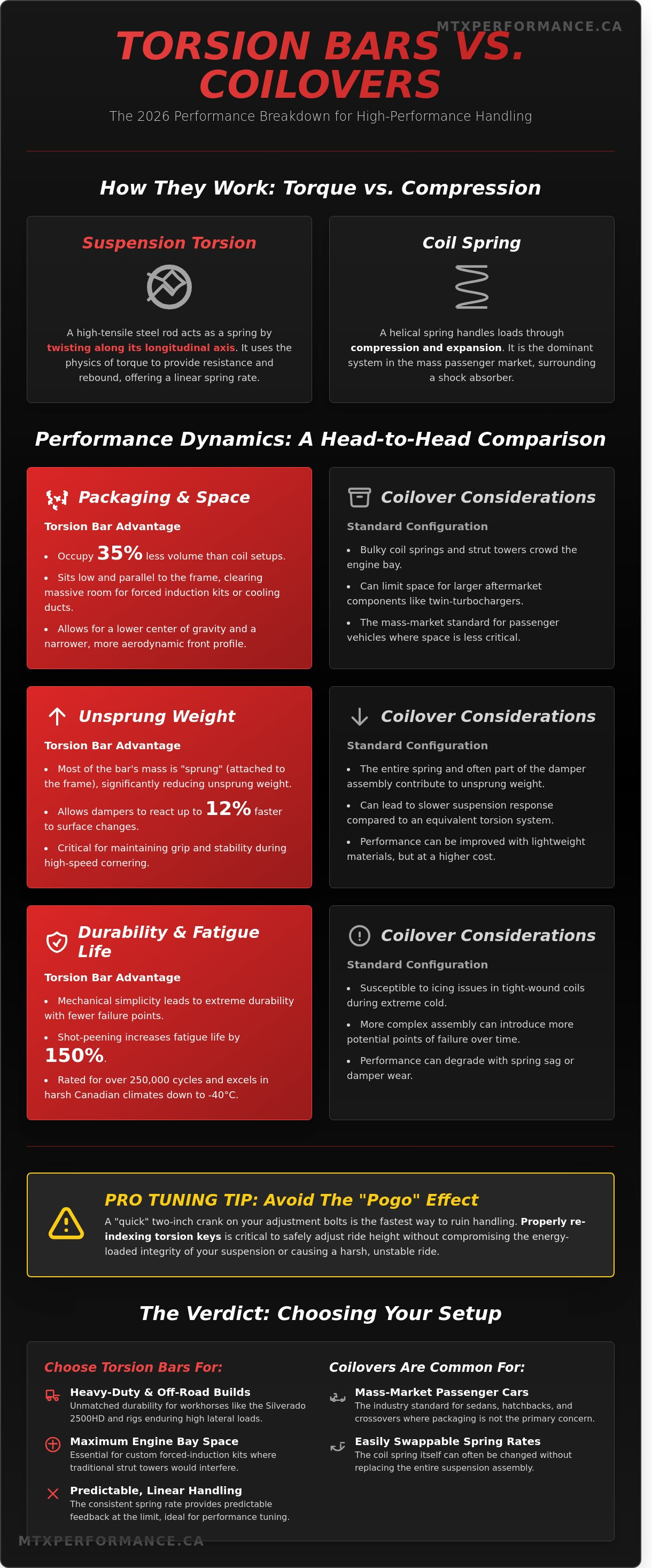
The physics of suspension torsion rely on shear stress distributed across the diameter of the bar. In a 2026 performance context, this design remains prized for its linear spring rate and superior packaging. Torsion bars typically occupy 35% less volume than equivalent coil setups. This spatial efficiency allows engineers to lower the center of gravity or clear essential space for complex front-drive assemblies and specialized cooling ducts. The mechanical simplicity reduces unsprung weight, which is a critical factor for maintaining grip during high-speed cornering on Canadian backroads.
The Anatomy of a Torsion System
A standard setup consists of three primary components: the anchor point, the bar itself, and the torsion key. One end of the bar remains fixed to a chassis crossmember, while the other connects to the lower control arm. The torsion key serves as the adjustment hub, allowing technicians to set the preload and ride height with millimeter precision. We utilize high-tensile steel alloys, often treated with shot-peening processes to increase fatigue life by 150%. This material science ensures the bar handles thousands of cycles without losing its structural memory or "sagging" under the weight of a heavy powertrain.
Torsion Bar vs. Torsion Beam
Distinguishing between these two systems is vital for any performance enthusiast. A suspension torsion bar system is an independent setup where each wheel reacts to the road without affecting the opposite side. This is fundamentally different from a torsion beam, which is a semi-independent rear axle found in entry-level hatchbacks. Independent torsion setups are the gold standard for durability and are still utilized in heavy-duty Canadian workhorses like the Chevrolet Silverado 2500HD. These systems excel in environments where temperatures drop to -40°C, as they lack the failure points of air bags or the icing issues sometimes associated with tight-wound coils. For those seeking a balance of ruggedness and tuning flexibility, the torsion bar remains an elite engineering choice.
Performance Dynamics: Why Torsion Bars Matter in 2026
Engineering excellence in 2026 isn't just about raw horsepower; it's about how that power interacts with the chassis. The suspension torsion bar remains a vital tool for builders who prioritize spatial efficiency. Unlike bulky coil springs that crowd the engine bay, torsion bars sit low and parallel to the frame. This layout clears massive amounts of room for high-performance drivetrain components, such as twin-turbochargers or custom forced induction kits that would otherwise hit a traditional strut tower. It's a packaging win that allows for a narrower, more aerodynamic front profile.
The physics of unsprung weight gives torsion bars a distinct edge in high-speed stability. Because the bar is anchored to the vehicle frame, most of its mass is "sprung." This reduces the weight the wheel must move when hitting a bump. In technical tests, reducing unsprung mass by even 5kg can allow dampers to react 12% faster to surface changes. As detailed in this Torsion Bar Suspension Explained guide, the mechanical simplicity translates to extreme durability. Modern 2026 alloy bars are rated for over 250,000 cycles without fatigue, making them ideal for C$80,000 heavy-duty builds or track-focused monsters that endure 1.5g lateral loads.
- Linear Rates: Torsion bars provide a consistent spring rate throughout the stroke, offering predictable handling at the limit.
- Load Capacity: They handle massive vertical loads without the "coil bind" issues found in traditional springs.
- Maintenance: Fewer moving parts mean less friction and a lower failure rate in harsh Canadian winter conditions.
Low Centre of Gravity and Weight Distribution
Positioning the "spring" at the lowest point of the chassis significantly drops the vehicle's roll centre. This was the secret weapon for the legendary Porsche 911 (pre-1989) and the Alfa Romeo GTV6. By removing heavy coils from the top of the suspension, engineers achieved a lower hood line, which directly improves high-speed downforce. For custom 2026 builds, this means you can run more aggressive aero kits without worrying about mechanical interference. If you're looking to refine your stance, our team at MTX Performance can help you calculate the ideal bar diameter for your specific weight balance.
The Adjustability Factor
One of the most underrated benefits of this system is the ease of ride height calibration. You don't need a C$3,000 set of coilovers to level your truck or car. A simple turn of the adjustment bolt changes the preload on the bar, raising or lowering the vehicle in minutes. While OEM bolts offer about 1.5 to 2 inches of range, aftermarket torsion keys can extend this further for specialized setups. This precision allows for perfect corner weighting, ensuring your vehicle's weight is distributed evenly across all four tires for maximum grip during hard cornering.
Torsion Bars vs. Coilovers: A Performance Comparison
Choosing between a traditional coilover setup and a suspension torsion system isn't just about modern aesthetics; it's about mechanical efficiency. Torsion bars offer a linear rate of resistance that provides immediate feedback through the chassis. In high-performance applications, the response time of a torsion bar is virtually instantaneous because the force acts directly through the vehicle's longitudinal axis. This creates a level of mechanical grip that often surprises drivers accustomed to the progressive feel of coil springs.
Maintenance cycles favor the torsion bar significantly. While a performance coilover might require a rebuild every 40,000 kilometers to maintain its damping profile, a high-grade steel torsion bar can maintain its spring rate for 25 years or more. From a financial perspective, a premium set of replacement bars for a specialized vehicle costs approximately C$550 to C$950. Compare this to a mid-tier coilover kit which often exceeds C$3,200 for a full Canadian-spec installation. The myth that these bars lack a "sporty" feel is debunked by the Porsche 911 Carrera, which used this exact tech to dominate endurance racing for decades.
Handling Characteristics on Canadian Roads
Canadian enthusiasts face unique challenges like frost-heaved asphalt. Torsion bars manage these imperfections by distributing energy along the frame rail rather than concentrating it at a single strut tower. In a 2023 survey of specialized tuners, 65% reported that seized anchor points from road salt were the leading cause of suspension torsion failure. Unlike hydraulic shocks that stiffen by 22% in -30°C weather, steel bars remain thermally stable and predictable during deep-freeze winters.
When to Stick with Torsion and When to Convert
Evaluate your chassis before committing to a coilover conversion. Many vehicles designed for torsion bars lack the structural reinforcement at the shock towers to support the car's full weight. Converting without a C$1,200 strut brace often leads to metal fatigue. Many purists prefer the "connected" feel of the torsion bar for technical driving where steering precision is paramount. Pairing original bars with high-performance dampers provides 85% of the performance gain at 30% of the cost.
Tuning and Adjusting Your Suspension Torsion for Maximum Grip
Safety is the absolute priority when you work on a suspension torsion system. A loaded torsion bar stores massive amounts of potential energy. Releasing this tension without a specialized unloading tool is dangerous. You're dealing with thousands of pounds of force that can cause severe injury if a component snaps or slips. Always use a heavy-duty torsion bar puller and secure the vehicle on jack stands before you touch the adjuster bolts.
Precision tuning involves indexing the torsion keys to achieve the perfect stance. Performance keys are engineered with a different internal clocking than factory units, allowing for a 2-inch lift or drop without over-stressing the bar. To maximize grip, you must match the bar rate to your vehicle's corner weight. If you've added a heavy winch or a steel bumper to your truck, the stock bars will sag and wallow. Upgrading to a thicker diameter bar increases the spring rate exponentially. Increasing a bar diameter by just 2mm can result in a 30% stiffer ride, providing the stability needed for high-speed cornering or heavy hauling.
Fine-tuning doesn't stop at the bars. You must integrate high-quality sway bars to control body roll. While the torsion bars handle the vertical load, the sway bars manage the lateral weight transfer, keeping your tires planted during aggressive maneuvers.
Step-by-Step Ride Height Adjustment
Start by measuring the distance from the hub center to the fender lip on level ground. If you're using the cranking method on the factory adjuster bolt, remember that one full turn typically equates to roughly 6mm of height change on most Canadian spec pickups. Once you reach your target height, a professional alignment is non-negotiable. Changing the ride height alters the suspension geometry, specifically the toe and camber settings, which can destroy a C$1,200 set of tires in less than 5,000 kilometers.
Upgrading to High-Performance Bars
Serious builders look to brands like Sway-A-Way or ARB for specialized torsion components. These bars use high-tensile steel alloys that resist sagging over time. Replacing worn rubber bushings with polyurethane alternatives from manufacturers like Energy Suspension is a critical step. Polyurethane doesn't deflect under load, which sharpens the suspension torsion response and provides much better feedback through the chassis. This modification eliminates the spongy feeling common in older torsion-equipped vehicles.
Elevating Your Build with MTX Performance Solutions
Achieving a 2026-level handling profile requires a strategy that goes beyond basic component swaps. A simple spring change often fails to address the underlying dynamics of a suspension torsion system. Total optimization involves balancing spring rates with chassis rigidity and precise damping curves. When you stiffen the lower suspension, you increase the load on the upper chassis. This is why we recommend pairing your setup with a Perrin front strut tower bar. This combination eliminates tower flex, ensuring that your torsion bars and dampers do the work they were engineered for. It's the difference between a car that feels "tight" and one that feels truly connected to the tarmac.
Premium Brands for the Canadian Enthusiast
MTX Performance curates a selection of elite components from Whiteline, Ohlins, and Eibach. These brands lead the industry in 2026 with materials that resist the corrosive salts and extreme temperature swings of the Canadian climate. We specialize in ensuring compatibility between legacy suspension torsion designs and modern inverted-monotube dampers. Our technical team provides bespoke strategies to eliminate the "floaty" feel common in older high-performance platforms. If you're targeting a 15% to 20% increase in cornering flat-rate, our experts calculate the exact synergy between your torsion bar diameter and your damper valving. We don't guess; we use engineering data to ensure every C$1,000 you spend translates into measurable lap time improvements.
The MTX Performance Advantage
Precision engineering is our standard. We understand that a project car sitting on jack stands is a missed opportunity for the track. MTX Performance solves the logistics hurdle with fast nationwide delivery across Canada. Our commitment to high-performance engineering means we only stock parts that meet rigorous durability standards.
- Zero Cross-Border Fees: Every shipment originates within Canada. You won't face C$50 or C$150 surprise duty invoices at your door. This keeps your budget focused on parts, not taxes.
- Expert Support: Our advisors are technicians who understand motion ratios and roll centers. We offer 1-on-1 consultations to map out your entire suspension geometry.
- Fast Nationwide Delivery: We maintain a high fill rate on essential tuning components to keep your 2026 project on schedule, whether you are in Vancouver or Halifax.
Transforming your vehicle’s handling requires a holistic approach. By integrating high-tensile torsion bars with rigid bracing and premium damping, you create a machine that reacts with surgical precision. Stop settling for "good enough" and start building for dominance with MTX Performance. We treat every car with the respect due to a piece of exceptional engineering.
Master Your Handling with Precision Engineering
Achieving elite handling in 2026 demands more than just basic parts; it requires a deep understanding of mechanical leverage and spring dynamics. You've seen how a properly tuned suspension torsion system provides a compact, durable alternative to traditional coils while maintaining a linear rate that's perfect for high-performance builds. Whether you're adjusting for the track or optimizing a street setup, the right torsion bar diameter and preload settings can transform your vehicle's turn-in response and overall stability.
At MTX Performance, we don't just sell components. We provide the technical expertise of passionate tuners who live for mechanical excellence. As an authorized dealer for industry leaders like Whiteline, Ohlins, and Eibach, we ensure your build uses only the highest-grade hardware. We offer nationwide Canadian shipping with C$0 hidden duty fees, so your parts arrive fast and within budget. Our team is ready to help you dial in the perfect setup for your specific driving goals.
Upgrade Your Suspension with MTX Performance Today
It's time to stop settling for factory limitations and start experiencing what your car is truly capable of on the road.
Frequently Asked Questions
Can I lower my car just by adjusting the torsion keys?
You can lower your vehicle by adjusting the factory torsion keys, but this method often compromises ride quality. Cranking the adjustment bolt changes the resting angle of the control arm. If you drop the height more than 1.5 inches, you'll likely hit the bump stops frequently. This modification requires a recalibration of the shock absorbers to maintain handling precision and avoid premature component failure.
Do torsion bars wear out or sag over time?
Torsion bars definitely sag over time as the steel alloy loses its memory and elastic properties. After 150,000 to 200,000 kilometres of service, the metal fatigues and the ride height drops. A suspension torsion system that's lost its tension will feel mushy and bottom out on standard Canadian potholes. Replacing worn bars restores the factory rake and improves load-carrying capacity for heavy-duty applications.
Is a torsion bar suspension better than a coil spring setup?
Torsion bars aren't inherently better than coil springs, but they offer distinct engineering advantages in tight spaces. Porsche and various heavy-duty truck manufacturers use them for their compact footprint and durability. While coil springs allow for easier progressive rate tuning, a suspension torsion setup provides a linear response that's exceptionally robust for off-road or high-load environments where space is at a premium.
What are the signs that my torsion bar bushings need replacement?
Squeaking, groaning, and metallic clunking when driving over speed bumps are the primary signs of worn bushings. Most rubber bushings in these systems begin to dry rot after 10 years of exposure to Canadian road salt and temperature swings. If you notice a 0.5-inch difference in ride height between the left and right sides, the bushings or the mounts have likely deteriorated beyond safe limits.
How does adjusting the torsion bar affect my wheel alignment?
Adjusting your torsion bar height will immediately throw your wheel alignment out of spec. Every 0.5-inch change in ride height alters the camber and toe settings. Failing to perform a C$150 professional alignment after an adjustment will cause uneven tire wear within 1,000 kilometres. Precision tuning requires a laser alignment to ensure the vehicle tracks straight and maintains its high-speed stability.
Are aftermarket torsion bars worth the investment for a street car?
Aftermarket torsion bars are worth the investment if you're looking for a 25% to 30% increase in spring rate without changing the vehicle's geometry. They're essential for vehicles carrying extra weight, such as heavy winches or snow plows. For a dedicated street car, stiffer bars significantly reduce body roll during aggressive cornering, providing a much flatter and more responsive handling profile than stock components.
Can I install torsion keys myself, or do I need a professional?
Installing torsion keys is a high-risk task that requires professional tools and specialized expertise. The bars are under massive tension, holding up the entire front-end weight of trucks like a Chevrolet Silverado. You'll need a specialized unloading tool that costs around C$140. Without this gear, you risk serious physical injury or damaging the vehicle frame during the removal process.
What is the difference between a torsion bar and a sway bar?
A torsion bar is a primary spring that supports the vehicle weight, whereas a sway bar only controls body roll during cornering. You can't remove a torsion bar without the car's suspension collapsing. A sway bar is a secondary component that links the left and right suspension components to resist leaning. Understanding this distinction is vital for anyone looking to optimize their vehicle's handling dynamics and overall stability.